Wisdom Lane Antiques would love to wish everyone a Happy Thanksgiving and that you also have a great time with the entire family.
Make sure you save me a drumstick!
HAPPY THANKSGIVING!
Wisdom Lane Antiques would love to wish everyone a Happy Thanksgiving and that you also have a great time with the entire family.
Make sure you save me a drumstick!
HAPPY THANKSGIVING!
When I am trying to find some information on an item that I recently purchased, I run across some fun facts that happened during a certain year. Here’s what I recently ran across for the year 1890:
February 24—Chicago is selected to host the Columbian Exposition.
June 16—Stan Laurel (an English-born actor and member of the comic duo Laurel And Hardy) was born on this day.
June 20—The book titled The Picture Of Dorian Gray by Oscar Wilde is published Lippincott’s Monthly Magazine.
Do you know what was invented in San Francisco in 1890? The Jukebox.
It’s always fun for me to see these fun facts, I never know what I will run across. What fun facts have you run across?
There is a ton of pottery out on the market, how do you know what’s what? And how do you read the mark on the bottom of the piece to know what you have in your hands?
Figuring out the mark on pottery is pretty easy. Here are a few things to keep in mind when you are looking at a mark:

*With artists being hired on by the pottery companies to hand paint some items, the artist would sign their name to the piece as well. Collectors not only collect certain pottery lines, they also look for a certain artist. A word of advice on this though—if the piece is not signed by the artist on the bottom, then look at the area that is hand painted. The artist’s signature will not too far away from it.
*The name of the pattern can be on the bottom as well. The Frank Beardmore creamer’s pattern is called “A Sussex Homeland,” and the pattern is listed at the top of the mark on this piece. I have seen the pattern name both incorporated into the mark and standing by itself, so keep an eye out for it.
The marks on pottery are not that hard to decipher, it just takes a minute to figure out how the maker wrote it on the piece.
What kinds of pottery have you found something out by looking at the mark?
Over Time, there have been plenty of items that have fallen out of favor for one reason or another. It could be a different type of record player, radio or even a Television.
Take this child’s bowl that has been designed with a built-in container to hold hot water to keep the food stored in it warm.

It is still very functional, but with the advancements of electricity and the invention of hot plates or warmers (or even microwave ovens, for that matter) it has become easier to keep your kids food warm for them.
The bowl has a built-in spout with a removable lid so you can get the water in and out without having a problem.

All that you have to do is to pour some water into the spout and seal it up. After that, you are good to go. The bowl is kind of like the travel mugs that we have around today.
What kinds of items like this that have fallen out of favor have you run into?
Whenever I am out and about at an antique mall or flea market, there are some basic rules of etiquette that I follow.
Here are a few of them:
Put items back where you found them. You picked up an item with the intention to buy it, and along the way you decided not to. That’s more than fine—make sure to put it back where you found it. Antique malls and flea markets have booths for dealers to stock with their items—this way the dealer gets their items back.
If you happen to bring a drink in with you, see if it is ok to bring it in with the people that run the shop. I have run across several shops that don’t allow food or drinks in the front door.
Make sure that you follow the golden rule of antique shopping—buy what you like when you see it. If you let it go, it might not be there when you come back for it.
And remember to watch where you walk and keep an eye on your large bags or purses that you bring with you. There is one rule that I have seen stores enforce quite a bit—you broke it, you bought it.
This is a small handful of the common etiquette that you will run across while antique shopping. What have you run across?
The Homer Laughlin China Company of Newall, West Virginia opened for business in 1871.

From then to now, they have produced dinnerware (and even kitchenware), and many of the lines are still popular to this day. Examples of these lines are Fiesta, Virginia Rose, Harlequin, Rhythm, Nautilus, Swing, Riviera and even Century.

Most of the dinnerware is marked by Homer Laughlin, so identifying a manufacturer is not a problem. Some of it features the name of the pattern as well, which helps out a lot. The HLC trademark is usually followed by a number series, the first two digits will indicate the year. So, if you do run across a Homer Laughlin piece that doesn’t have the name of the pattern on it, you can most likely narrow it down with the year mark.

I’m partial to the restaurantware that Homer Laughlin made (a piece of it can be seen in the first two pictures). I have always thought that the piece was made for extra ware and tare, so I don’t have to be so delicate with it.
What kind of finds do you have in your collection?
I have been attending auctions since I was 8, and I know that they have been around since the times of ancient Rome. What are some fun facts when it comes to auctions?
Some of the first auctions were held in ancient Rome. Like modern times, the people of ancient Rome would sell off household goods like furniture to pay off debts. These auctions could last for months.
When the items that were seized by the Army during the American Civil War, they would be sold by the Colonel of the Division. That’s why you see some auctioneers carry the title of “Colonel”.
With the invention of the internet, it is now very possible to find and attend any auction that you could ever want. This is a great way to help you find that piece that can help you complete your collection.
This is just a handful of fun facts about auctions. What fun facts have you heard?

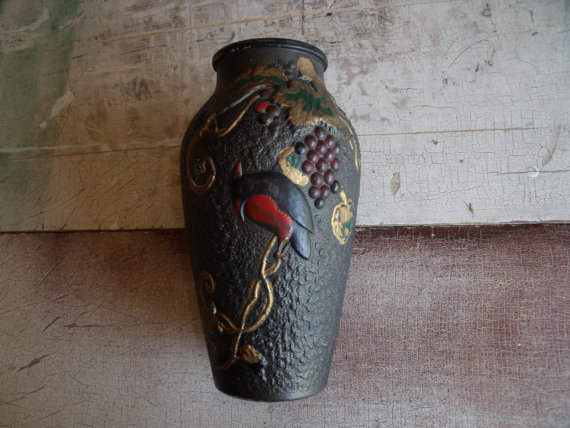
Goofus glass was made in the early 1900’s and was the first type of carnival glass giveaway because it was relatively cheap to make. Plates, bowls, vases (like the one above), and even oil lamps were made in mass quantities.
The glassware was also made with highly decorative patterns like the one on the vase above. The pattern on the vase featured here is called, “Odd Bird Sitting On A Grape Vine.” The bird on the vase looks like it could have come out of a comic book!
The great thing about goofus glass is that it comes in a wide variety of colors form what’s on the vase to red, gold and even green. With a wide variety of colors and shapes, you could find the perfect piece and color combination for any room.
One thing that you need to keep an eye on is the paint itself. Since the paint was not fired on, it tends to flake off. So if you are patient, you will find a piece of Goofus Glass with all of its original paint intact.
Another thing that’s great is that goofus glass can be seen from flea markets to swap meets to even antique stores and shows. You never know what you’ll find where!
What kinds of patterns and pieces of goofus glass have you found or run across?
Several years ago, I was shopping at one of the local antique malls that is in the area that I live. I happened onto something that could be worth some money. The item that I ran across happened to be a large shaker or even a hat pin holder by R. S. Suhl.

With the price being right (and there being a little wear present on the bottom of the shaker), I went ahead and bought it. When I went to find out what I could about the mark so that I could list it online, there was a little voice in the back of my head that was saying something was not right.

After a few minutes of searching online, I found a shaker just like the one that I just bought. I was so thrilled to find it! I started to read what was posted online about it, and sure enough that little voice was right—the shaker was indeed a fake.
What was the lesson I learned? A little research and knowledge can go a long way in life.
Have you found something like this that turned out to be a fake after you bought it?
You have decided to take the plunge and attend an estate sale that is nearby. You have one in mind, but what are some tips to remember for when you go?
Dress comfortably—when attending a sale, it’s a good idea to wear comfortable shoes. There can be a good amount of walking to and from the sale, and even at the sale itself.
Have something to pack with—the sale that you attend may not have anything for you to pack your purchases with, so it is a good idea to bring some bags or a couple of boxes to put your items in.
Don’t be shy—there will be a time that you may not know what an item is, or you may even want to talk to someone about a price. The people that are holding the sale will be more than willing to help, so feel free to talk to them.
Bring a measuring tape—this might sound a bit silly, but there have been times a measuring tape has been handy. There have been times when I need to know the size of something like a picture frame and I even used it to see if an item would fit into my car.
This is a very small amount of tips to remember for when you attend an estate sale. What tips have you run across?