How do I price an item so I can sell it online or in a booth?

You have been shopping at flea markets, auctions and even thrift stores for a while now.  You have gotten several good deals now, and you have decided to make the plunge and sell some of the deals off either in a booth or online.

You have suddenly run into a problem with selling—how much do you charge on the item you want to sell?

This is a simple solution.  You need to ask yourself a very simple question—can I legitimately double what I paid for the item?  If you can double what you paid, then you are good to go.

Now, you need to remember one thing about pricing—you can’t just pull a number out your ear to say this is what you paid.  You need to keep good financial records not just on what you sell an item for, you also need to keep track of what you paid as well.

You need to keep your receipts for your records as well.  This helps prove what you paid in case you have a question later on arise.

The problem with the antiques and collectibles area is that there are going to be times that you do not get a receipt.  So, how do you prove that you paid a certain price for an item?  You will need to write it down on a piece of paper what you paid, where you bought it and the date that it was purchased.  Doing this will help go a long way in helping out.

One trick that I do is to keep things like a packing slip as well if I happen to buy something online.  The packing slip will have all of this listed on it, so it could stand in as a receipt if you don’t have anything else.

Now that you have a price for the item you want to sell, how fast do you think it will sell?
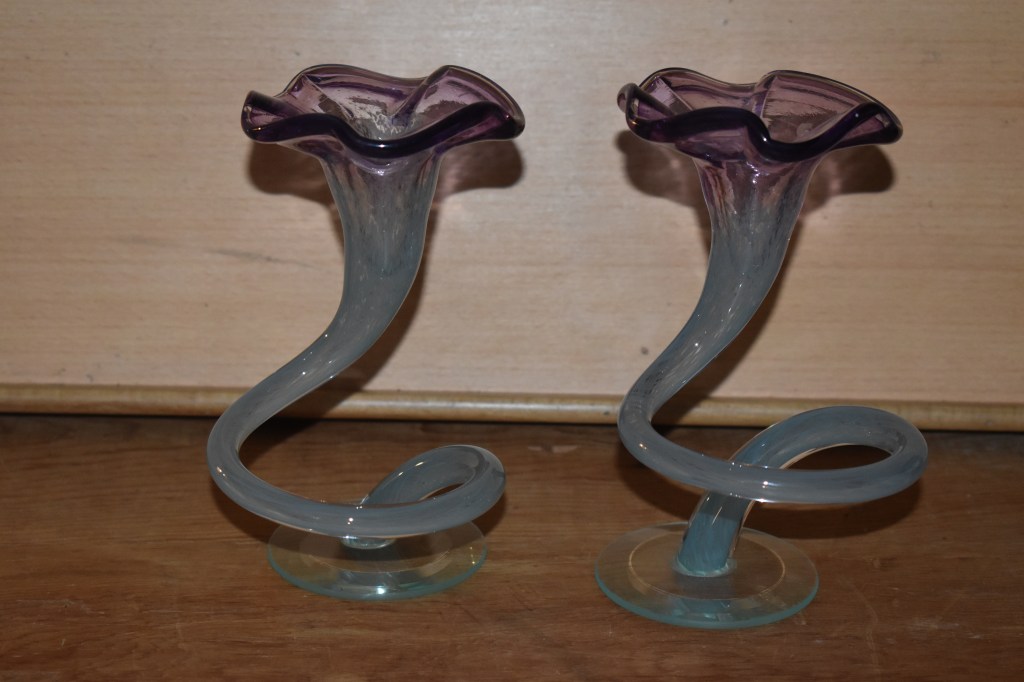
What are some tips for the background when photographing items to list online for sale?

When it comes to taking some photos of an item that is going to be for sale, there will be some things that you will do to make sure the photos come out alright.

You will make sure that the item is well lit in the photos, any damage will be photographed, and you will even put a prop with the item to give a size comparison to.  But what about the background?

If you think about it, the background will often get ignored when you take some photographs.  The background will play as big of a roll as the rest of the photograph.  Look at the two photos and compare them to each other—do you notice the difference?

The most glaring thing about the two photographs is the background.  More importantly, the color of the background.  It makes the pair of Murano candleholders look completely different, almost like they are two completely different sets.

The best piece of advice that I can give you when it comes to the background is that you need something that doesn’t overpower what the star of the show should be.  One of the things I do is to go with a lighter color than the item that I am photographing.

Another thing I do is I might stage the photograph and make it place that they are designed for, like on a kitchen table.  You can even go so far and put a plate and some silverware between you and the candleholders so you can show the potential buyer what it might look like in their home.

These are just a few tips that you can use when you take your photographs for the items you are going to list for sale.  What are some of the tips and tricks that you have come up with?

A little research can go a long way!

Several years ago, I was shopping at one of the local antique malls that is in the area that I live.  I happened onto something that could be worth some money.  The item that I ran across happened to be a large shaker or even a hat pin holder by R. S. Suhl.

With the price being right (and there being a little wear present on the bottom of the shaker), I went ahead and bought it.  When I went to find out what I could about the mark so that I could list it online, there was a little voice in the back of my head that was saying something was not right.

After a few minutes of searching online, I found a shaker just like the one that I just bought.  I was so thrilled to find it!  I started to read what was posted online about it, and sure enough that little voice was right—the shaker was indeed a fake.

What was the lesson I learned?  A little research and knowledge can go a long way in life.

Have you found something like this that turned out to be a fake after you bought it?