What a truly odd bird!

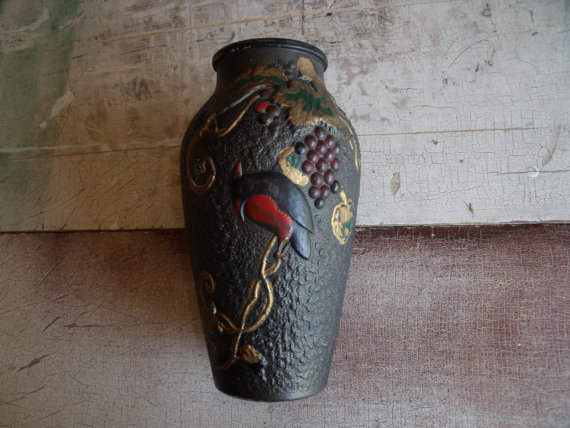
Goofus glass was made in the early 1900’s and was the first type of carnival glass giveaway because it was relatively cheap to make.  Plates, bowls, vases (like the one above), and even oil lamps were made in mass quantities.

The glassware was also made with highly decorative patterns like the one on the vase above.  The pattern on the vase featured here is called, “Odd Bird Sitting On A Grape Vine.”  The bird on the vase looks like it could have come out of a comic book!

The great thing about goofus glass is that it comes in a wide variety of colors form what’s on the vase to red, gold and even green.  With a wide variety of colors and shapes, you could find the perfect piece and color combination for any room.

One thing that you need to keep an eye on is the paint itself.  Since the paint was not fired on, it tends to flake off.  So if you are patient, you will find a piece of Goofus Glass with all of its original paint intact.

Another thing that’s great is that goofus glass can be seen from flea markets to swap meets to even antique stores and shows.  You never know what you’ll find where!

What kinds of patterns and pieces of goofus glass have you found or run across?

A little research can go a long way!

Several years ago, I was shopping at one of the local antique malls that is in the area that I live.  I happened onto something that could be worth some money.  The item that I ran across happened to be a large shaker or even a hat pin holder by R. S. Suhl.

With the price being right (and there being a little wear present on the bottom of the shaker), I went ahead and bought it.  When I went to find out what I could about the mark so that I could list it online, there was a little voice in the back of my head that was saying something was not right.

After a few minutes of searching online, I found a shaker just like the one that I just bought.  I was so thrilled to find it!  I started to read what was posted online about it, and sure enough that little voice was right—the shaker was indeed a fake.

What was the lesson I learned?  A little research and knowledge can go a long way in life.

Have you found something like this that turned out to be a fake after you bought it?

How do you know if the piece you have is truly rare?

One of the words that I hear a lot when I am shopping at a local flea market or even on the internet is the word “rare”.  What goes into labeling an item rare?

The first thing to consider is how many pieces were originally made.  The fewer the items that were made means that there are not as many on the secondary market.

Materials that an item is made of will help drive rarity.  For example, enamelware will have quite a few common items, and one of the collectible areas for enamelware is called “End Of The Day”.  These pieces were literally made at the end of the workday and have at least 3 different colors on them.  The employees that produced this type of item used up the excess materials that were left after a full day’s work.  With this, there will be some interesting color combinations on different pieces.

Another thing to consider is how often an item is used.  This could be a toy that is played with or even a piece of jewelry that is worn.  The more an item is used, the more wear and tear (and even damage) can occur.  It is harder to find an item that is used every day that’s in excellent or even mint shape.

Items like clothing, glassware or even pottery are going to be more fragile.  This will lead to chips, moth holes, cracks, or even rips and tears.  Damage like this will help drive up the price of the good examples.

Handmade pieces also tend to be rare as well.  This is a wide range of items that include autographs, paintings, tramp art, and even furniture.  Because they are handmade (rather than mass produced items), they are one-of-a-kind pieces.  Collectors are often willing to pay more for an item they love that they will never see again!

We all know that plenty of homework helps uncover what items are truly rare!  What kinds of rarities are you on the hunt for?

What are some glass terms that you will run across?

Whenever you go out to an antique mall, flea market or even an auction, you will hear some terminology that describes areas of collecting.

Here are a few words that you will run across when you hear people talk about glass:

Frosting—this is a matte finish that is produced by exposing the glass item to fumes of hydrofluoric acid.  This is also a small patch of surface cracks by weathering.

Ice glass—this is a decorative effect that causes the surface of the glass to resemble cracked ice.  This is accomplished by plunging a piece of hot glass into cold water as quick as possible.  This process creates a finish to the glass that resembles cracks.

Luster—this shiny metallic effect is made by painting the surface of the glass item with metallic oxides that is dissolved in acid and mixed with an oily medium.  The item is fired in oxygen free conditions which cause the metal to deposit a distinctive shiny surface after it is cleaned.

Opal glass—this is a glass item that looks like an opal being translucent and white, and it has a grayish or bluish tinge to it.

This is a small look at some of the words that you will hear about glassware.  What are some of the words you ran across?

I have started a collection on an area that I love. Now what?

Not too long ago, you have made the leap and started a collection on what you love.  Not only that, you also found a few pieces to add to that collection.

Now that you have accomplished all of this, what are some things to keep in mind?

After a little time to get your collection really going, you can narrow down the focus of your collection to several smaller areas.  This can be collecting Morgan dollars and Capped Bust half dollars if you are a coin collector or to collect Fenton and Northwood Glass if you collect glassware or even Carnival Glass.  This help keep you interested in your collection.

There are going to be times that you will have to sell off a part of your collection.  I know that this sounds counterproductive, but this prevents hoarding.  Not only that, it also helps keep your collection funded.

Keep your mind open to trading.  This way you can take similar items that are in your collection and trade them for an item that you really want to add to your collection.

Learn as much of the history on your collection that you can.  Not only does this help you with identifying the real from the reproductions, you can also tell people about what you collect.

This is just a few tips on collecting.  What tips have you heard?

Beginners tip: what are some auction no-no’s?

You are new to the auction world, and you have found one that is close by that you want to attend.  What are some of the things that you need to keep in mind that you should not do?

Do not bid if you are not sure if you want to buy the item.

Do not bid just to drive up the price.

Do not be rude, especially to the auctioneer.  This is an easy way to get people mad at you, and it could also get you kicked out of the auction.

Do not go in unprepared.  When I go, I always have packing material and a box or two to pack everything that I buy.  Another good thing to bring is a two-wheeler to help move the heavy items.

Do not start bidding on an item at the highest amount you are willing to pay.  If you listen to the auctioneer for a second or two, you will hear them lower the price down until they get a bid on it.  If you are patient enough, you will get a good deal on the item you are bidding on.

These are a few no-no’s to keep in mind when you attend an auction.  What are others that you have heard of?

A buying lesson for the beginning shopper—make sure to check for damage!

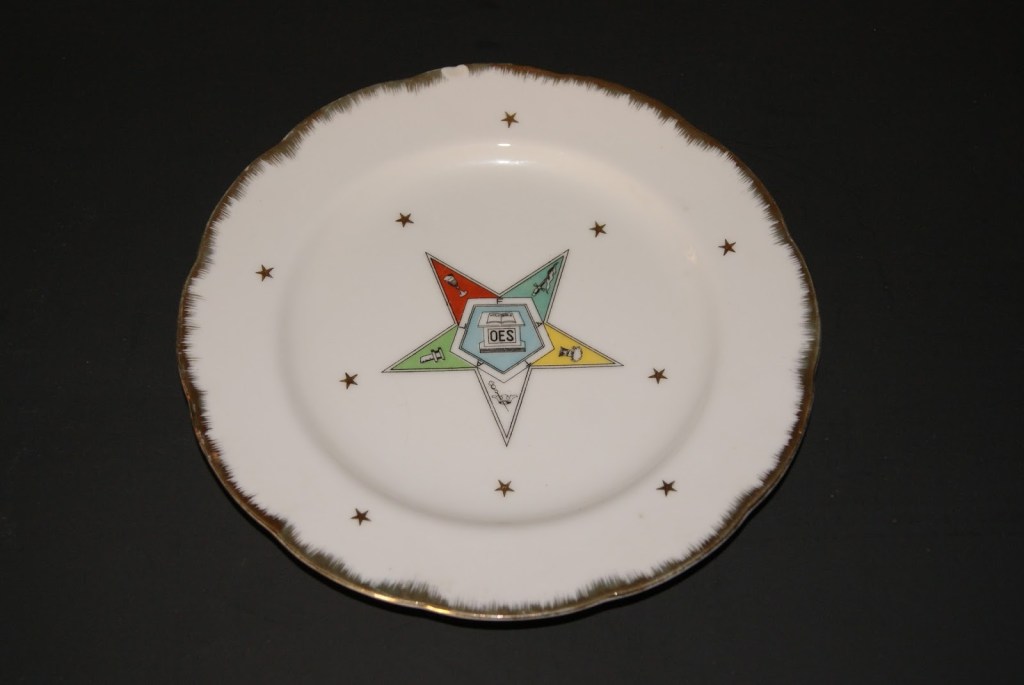
When I was at an estate sale not too long ago, I managed to find some really cool items.  One of the items was a Lefton salad plate made for the Order of The Eastern Star.

I had purchased it under the notion that the plate was in good shape.  When I got the plate home, I found the plate had a chip on the edge of it.

Today when we shop, we have the ability to use our cell phone to check out the worth and rarity of a piece that we are interested in.  To a great extent, it has diminished the need to go with your gut, but not completely.

You still have to be able to judge if in item is fake or real—and frankly to discover the flaws on an item.  You need to use your fingers and the light that is around you to discover chips and even cracks.

Fortunately for me, the purchase price of the plate was inexpensive, it was less than 5 dollars.

What kinds of mistakes have you made when you purchased an item?

How do you start a collection?

You have made the leap and started to attend some auctions, and you have even gone to antique malls and flea markets in your area.  You might have even gone to thrift stores and even some swap meets.  Then it hits you—how do you go about starting a collection of your own?

The first thing to do is to start a collection on what interests you.  If you love enamelware or even records, the best thing I can recommend is to start there—you never know what kinds of cool pieces you will find.

The second step is to figure out how much of a budget you can afford to spend on your collection.  It does not have to be big at first—over time you will want to expand your budget to help with buying the more expensive items.

You will want to spend time (especially when you first start a collection) on things like how to identify real from fake.  It can be a couple minutes a day worth of research to help you out in the long run.

A good tip to remember is to settle on a fairly wide area to start collecting in—this way you can narrow down the topic of your collection over time.  I have seen people start collecting in an area like coins and then settle on Morgan Dollars and Franklin half dollars.

It’s also perfectly fine to have several collections going on—this way you don’t get burnt out looking for just one topic.

When you start to shop for items to add to your collection, start out at shops, auctions and swap meets where you live.  This way you are not spending a lot of money on getting to where you are going. 

Another thing that you can do is to shop around online.  There have been plenty of times that I have run across items for sale online that are cheap enough that you can add it to your collection.

This is a small handful of tips to help with starting a collection.  What tips have you run across?

What are some of the popular toys from the 1980’s?

Every decade sees toys become extremely popular for a certain amount of time.  The Barbie doll started to gain popularity in the 1960’s, and the pet rock was popular in the 1970’s.  What toys were popular in the 1980’s?

1983 saw the Cabbage Patch Kids hit the toy shelves, and the rush was on to grab one anywhere that it was sold at.

When 1984 came about, The Transformers cartoon hit the airwaves.  The toys quickly followed, and they were as popular as the show was.  The race was on to find figures like Optimus Prime, Bumblebee and even the evil Megatron.

Nintendo released the Gameboy in 1989, and you quickly saw people playing games like Super Mario Land and even Tetris.

This is only a handful of the toys that were popular in the 1980’s.  What do you remember playing with?

Changing to the Kennedy Half Dollar

Photo courtesy of Wikipedia.com

When John F. Kennedy was assassinated on November 22, 1963, Mint Director Eva Adams was seriously considering changing one of the bigger denominations (either the dollar, half dollar, or the quarter dollar) to feature a portrait of John F. Kennedy.  Several days later, Eva Adams called up Chief Engraver Gilroy Roberts and told him that it was authorized.

Jaqueline Kennedy had expressed that she would love to see John on the half dollar, her reason was that she did not want George Washington to be replaced on the quarter.  This was taken into consideration and was also approved.

Photo courtesy of Wikipedia.com

There was one problem, and it was a pretty big problem.  There are laws on the books that state that United States coin designs can’t be changed for 25 years without Congressional approval.  The current half dollar design that was in circulation at the time features Ben Franklin on one side, and the Liberty Bell on the other (this design was first issued in 1948, some 16 years before the Kennedy design). 

Photo courtesy of Wikipedia.com

The good thing is that the new half dollar design passed with overwhelming support from Congress.  The Kennedy half dollar is still being made, but not many of them are readily seen in circulation today.  What’s better is that you can find new copies either from a coin dealer that is in your area, or you can order the coins directly from the United States mint.

Since there are plenty of Kennedy of half dollars that can be bought from either the bank or reputable dealers (both in a store setting and online), you can put together a complete set of coins for not that much money.  There are even people that look for different die varieties or coins that have errors.

Have you picked up one of these coins lately?