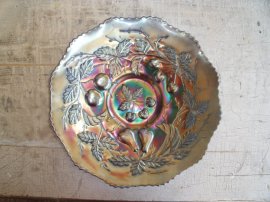
What a great carnival glass plate from Fenton!

When the 1900’s rolled around, a new form of glassware was introduced.  Over the years, it has become to be known as Carnival Glass—and there is a wide variety of manufacturers, shapes and colors.

Carnival glass was at the height of its popularity in the 1920’s when Fenton produced this terrific 12-Sided Amethyst Footed Plate with the THREE FRUITS pattern.

3

This terrific item is called a 12-sided plate because of the edge that it has—not only does it have a scalloped edge, it has 12 noticeable segments to it.

The THREE FRUITS pattern that is featured on this plate are cherries, pears, and apples.  Not only is the amethyst color great for just about any room, the pattern will also look great as well.

This great plate can be seen in my Etsy shop here.  What other great carnival glass items have you run across?

Is that early movie star MAE W. MARSH?

Mae W. Marsh was a huge movie star in the 1920’s—going from silent films to talkies.  She made nearly 100 films in her lifetime, and her career spanned 50 years.  Some of these movies include THE LESSER EVIL (1912), THE ESCAPE (1914) and even TIDES OF PASSION (1925).

Mae was a prolific actress, sometimes appearing in as many eight movies a year.  She also became a very popular actress, and she was featured on this terrific plate by STAR PLAYERS PHOTO COMPANY.

Mae W Marsh plate

STAR PLAYERS PHOTO COMPANY produced this fantastic plate in the 1920’s.  This plate with Mae W. Marsh was part of a series by the company that featured other movie stars.  This series had Charlie Chaplin, Anita Stewart, Francis X. Bushman, Marguerite Snow, Alice Brady, Maurice Costello, Lottie Pickford, Lillian Walker and other actor and actresses.

All of the plates in this set features a floral border, and a picture of the star in the center of the plate.  They are also the same size—they are about the size of a dinner plate.

What a wonderful find for the film buff, and you can see this great plate in my Etsy shop here!

What are some of the different types of plates that you will run across?

One of the first auctions that I attended, I found out that there are different types of plates when it comes to a set of dishes.  Here are some of the more popular ones that you will run across:

Dinner Plates—they are flat and usually round (there are other shapes like square out there).  Dinner plates range in size from 9 ¾ inches to 11 inches in diameter.

Salad Plate—these are also known as a side plate.  They are flat and usually round and range in size from 7 ¾ inches to 8 ¾ inches in diameter.

Bread & Butter Plate—these are also known as a dessert plate or even a cake plate.  Like salad plate, this type of plate is flat and usually round.  They range in size from 6 inches to 7 ¾ inches in diameter.

Luncheon Plate—they are often confused with the dinner or salad plates.  Luncheon plates are flat and usually round, ranges from 9” to 9 3/4” in diameter.

This is only a sample of all the different types of plates that you will run across.  What other types of plates have you seen?

Here’s some different type of dealers that you will find

There are several types of dealers that you will find, and some of the different types could be great for you to do if you are just getting started with antiques and collectibles.

Weekend dealers—these are dealers who shop at yard sales, garage sales, auctions and even estate sales on Fridays and Saturdays and then sell at flea markets on Sundays.  You can also find them in an antique mall occasionally, and this type of dealer is also called a “weekender”.

Vest pocket dealer—this is someone who buys and sells in coins but does not have a coin shop or store.  They also do not set up at coin shows, and they are often a part time coin dealer.  This type of dealer may not do a large volume of business, and they carry their coins that they are going to sell in their pockets.  Many coin dealers got their starts as vest pocket dealers.

Greeddobo—(greed-dough-bough) this is a term that is used by southern coin dealers for someone who is so caught up in making profits that they do stupid things or bad ideas to make money.  This term can be applied to just about any type of dealer who does this.

Wholesaler—this is a dealer who sells goods in large quantities at low prices to be sold off by others.

This is just a few of the different types out there.  What kinds of dealers have you run across?

Some of the terminology you hear about cleaning coins

When I first started to collect coins, I found several articles talking about cleaning coins.  I found out that there was a special vocabulary when it comes to this area.  Here’s some of the words that you will run across quite a bit:

Slider—this is a term meaning the coin simulates a higher grade than it really is. Often, a slider has been cleaned, treated, or whizzed to give it the appearance of being uncirculated or even Mint State.  This type of coin is worth less than the coin that has not been cleaned.

Whizzed—this is a coin that has been buffed or polished to give it the appearance of the luster found on a mint coin.  More often than not, whizzing is done on a slightly lower-grade coin to try to sell the coin at a higher grade than it really is.  This is sometimes done by using a fine brush attachment on a high-speed drill.  Doing this may hurt the value of a coin rather than help it.  This is because it causes wear to the surface of the coin.  See buffing.

Brushed—this is a coin that has been brushed with a wire brush or some other material.  The surface will show fine lines, or hairline scratches from the cleaning.

Buffing—this is a polishing of a coin with an abrasive that leaves a finish that attempts to counterfeit mint luster.  See whizzed.

Artificial toning—this is when you change the color or surface tone of a coin by applying chemicals, heat, or treating a coin with something.  This is done to make the coin appear natural or unusual.  It’s also done to cover up signs that the coin has been cleaned.

This is just a small list of what you will run across when it deals with cleaned coins.  What have you heard?

What are some different designing styles that you will run across?

Through the years, there have been some designing styles that have come about that have been very popular.  Art Deco, Mid-Century Modern and even Art nouveau are some of these, but what are some of the other styles that you will find?

Egyptian Revival—this style came about in the early 1920’s when the discovery of the King Tutankhamun was found.  This style ran at the same time as the Art Deco Style, and the Egyptian Revival influenced a number of items from architecture, jewelry and even furniture (the style has an Egyptian flair to it).

Baroque—this style is highly ornate and often extravagant style of architecture, décor and even music.  The style flourished in Europe from the early 17th century to the late 18th century, and this style evolved into an even more flamboyant style called “Rococo” when the 1740’s rolled around.

Streamline Moderne—this is a late type of the Art Deco Era, and it’s sometimes called Art Moderne.  It emerged in the 1930’s and it has emphasized curving forms, long horizontal lines, and sometimes it even has nautical elements to it.

This is only a small handful of the great styles that have come about.  What kind of style have you seen?

A little history for the Goudey Baseball cards from 1933

When 1919 rolled around, Enos Gordon Goudey started a chewing gum company called The Goudey Gum Company.  The company was in business until 1962, and they are known for chewing gum and the baseball cards that they produced.

The company and its gum was so popular that Enos Goudey was called “the penny gum king of America” by William Wrigley Jr. in 1933.

In 1933, the company dove into making baseball cards, and they released a 240-card set.  The set was also called BIG LEAGUE CHEWING GUM, and each pack that was sold came with a stick of gum.

After the set was released, the Goudey Company realized that they did not have a card #106 after collectors sent the company letters complaining that there was no card for that number.

In 1934, Goudey released a card #106, and it featured the retired player Napoleon Lajoie.  In order to get this card, you had to write to the company (they would send you one for a cent).

As you can tell from the photos, the cards had the name of the set at the bottom of the front and a little biography of the player on the back.

You need to be careful when you are out looking for cards for your set.  Since this is a popular set to collect, there are quite a few reprints and fakes of the cards—especially of Napoleon Lajoie, Babe Ruth (Babe was featured on 4 different cards) and even Lou Gehrig just to name a few.

There are many players that are in this set that have been inducted into the Baseball Hall of Fame, so a word of caution is to be taken when you are looking at a card.

Which cards have you run across?

What are the different types of manufacturing for enamel advertising signs?

Just about every area of antiques and collectibles can be divided into several different sub categories.  It could be collecting the denomination or country of origin of coins, a certain glass company or pattern, or even a certain type of manufacturing process like majolica pottery.

This is true for enamel advertising signs, and one of the ways you can do this is the style of manufacturing of the sign itself and how it can be displayed.

The first type is a flat one-sided sign.  This style has advertising on just one side of the sign, and this would be perfect to attach to a wall or the front of a building.  With only one side having the advertising, the back will have just one color of enameling.

The second type is called a flat two-sided sign.  This style has advertising on both sides of the sign, and most of the time this type of sign will be in a stand or frame of some type to help see both sides.

The third type of sign is a flanged two-sided sign.  This type of sign has a built-in 90-degree angled mount on it that allows the sign to come out from a wall or even a side of a building.

The next type of sign is called a curved sign.  This sign will have a curve in it to go around items like a telephone pole, a street light or even the corner of a building.

Another type are gasoline pump signs, and they will advertise the brand of gas that it is.  Not only are there gasoline pump sign examples for automobile gas, there are also some examples known for marine and aviation gas known as well.

The last example is called a neon porcelain sign, and this type has neon lights on it.  This type of sign can light up and you can see the sign better at night, and the most notable type is on a movie theater.  You could also find this hanging in a window of a business.

What types of enamel advertising sings have you run across?

What are some things to remember when you go shopping for antiques?

Whenever you go shopping for antiques, there are always a few things that you need to remember.  The first thing that you need to keep in mind is what kind of budget that you have.  What I do so that I don’t go over my budget is to write down on a piece of paper how much my bill will be.

Another thing to remember is to keep an idea (or even a list) on what you are looking for.  It could be a lamp for your living room, a carburetor for your Indian motorcycle or even a Morgan dollar for your coin collection.  I often look in reference books or on the internet to see how much the item that I am looking for will cost so that I know what to expect to pay.

The next thing that I do is to figure out where I would like to go.  You may have several antique stores, flea markets and even swap meets that are pretty close to home, so you could hit several of them in one day.

The last thing to do is to throw a box or a sack into your car or truck.  It might sound silly, but I have one when I go shopping—you may be at something like a garage sale or even a swap meet and need to pack something in it.

The best rule of thumb of all is to have fun!

What are some things to consider when it comes to restoring an item?

When do you restore an item?  Do you leave it well enough alone or do you restore it?  These are questions that you will hear when you are dealing antiques and collectibles, and it can be kind of hard to know what to do.

The first thing to know is how much the item is worth—both in its current form and what it will be worth after the restoration.  An effective way to do that is to get an appraisal on the item.  Ask the appraiser to give you an appraisal on both before and after values to see if it is worth it to restore the item.

If the item’s value will go up after the restoration, you need to keep in mind on what the item is.  If it’s something that you don’t feel comfortable restoring yourself (like a rug or a painting), then you will need to find a good conservator to help you out.

Be careful though—restoring an item could get to be a very expensive proposition.  I’ve seen restorations go from as little as $500 (for a painting) to well over $50,000 (for a car).  To help figure out what it will cost to restore your item, I would contact people who do restorations to get an estimate on what to expect.

The last thing to consider is if you want to do the restoration or to just do a few simple repairs to the item—after all, all the item may need is a good cleaning and one or two new items on it.