Nefertiti and the Whiskey decanter by Michter’s

When 1979 rolled around, a whiskey decanter was released and it featured something different, something that you may not expect to be on a whiskey decanter.  The decanter sports the bust of Nefertiti.

Nefertiti?  Who in the world is Nefertiti you say?  She was a Queen in ancient Egypt and the original bust was found in 1912 and has become one of the more famous artifacts that has come out of ancient Egypt.

It has become so popular that it is featured on items like this decanter from Mitcher’s.  When it was released, there was also another decanter that featured King Tut.

When Mitcher’s made the decanter, they really went all out and put a pretty good amount of detail onto the decanter.  It is also striking with the gold glaze that they put on it as well.

You can see the decanter in my shop on Etsy here.  Head on over and check it out!

What are some of the different types of pottery?

When you jump into the world of antiques and collectibles you will see a wide range of pottery that’s on the market.  It could be transferware, stoneware or even art pottery—you really never know what you could run across!

What are some of the different types of pottery that you will find?

Ironstone—this is a type of pottery that made its debut in the UK in the early 1800’s.  It is similar to fine stoneware and was developed by potters in Staffordshire England as a cheaper alternative for porcelain.

Agateware—this is a type of pottery that is decorated with a combination of clays that have contrasting colors.  The name of this type of pottery comes from the agate stone which has different colored layers in it.

Raku Ware—this is a type of Japanese pottery that is traditionally in Japanese tea ceremonies.  The pieces are fairly porous vesels that are a result from low firing temperatures and lead glazes.  The traditional process sees the fired piece removed from the hot kiln and allowed to cool in the open air.

This is a small portion of the different types of pottery that you will find on the market.  What types have you run across?

What’s in a maker’s mark on pottery?

There’s a ton of pottery out on the market that you will run across, but how do you know what’s what?  And how do you read the mark on the bottom of the piece to know what you have in your hands?

Here are a few things to keep in mind when you are looking at a mark:

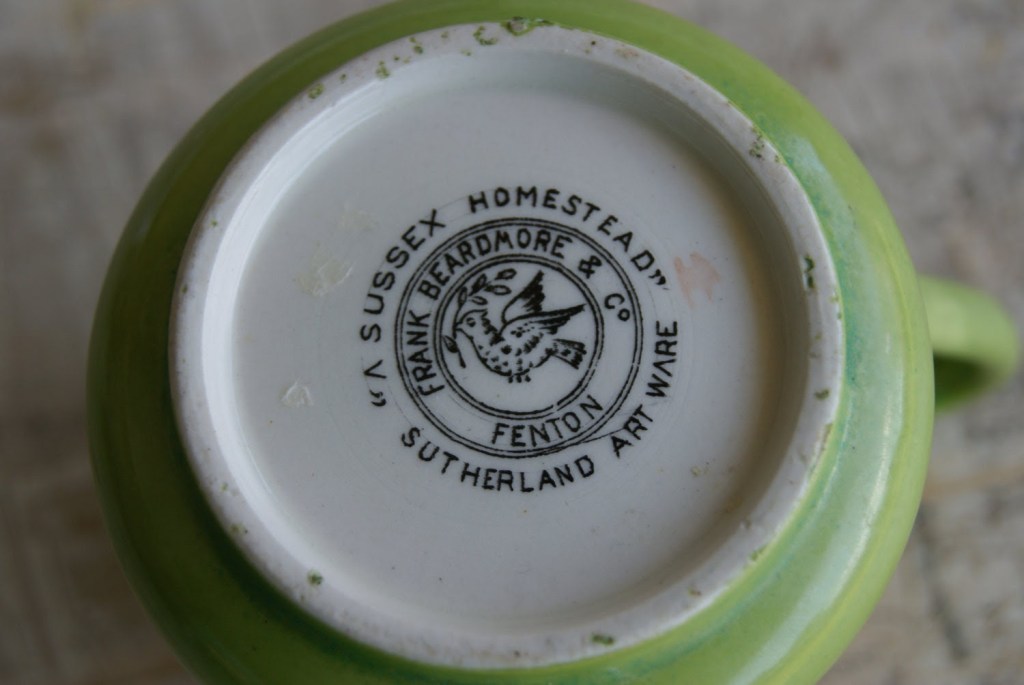
A maker’s mark will run a wide variety on how much information it will give you.  It could be just the name of the name of the company, or it could be loaded with information like the Frank Beardmore piece pictured above.  Since 1891, all pottery that is made to be exported (especially into the United States), it must be stamped with a country of origin near the maker’s label.

With artist’s being hired on by the pottery companies to hand paint some items, the artist could sign their name to the piece as well.  I have seen an artist signature to either the bottom of the piece or on the side of the piece (I would look near the bottom of the piece to see if the artist signed there).

There are times that the name of the pattern is written on the bottom of the piece as well.  The Frank Beardmore creamer’s pattern is called “A Sussex Homeland” and the name of the pattern is listed at the top of the mark on this piece.

A good tip to remember is that the marks on pottery are not that hard to decipher; it just takes about a minute to figure out how the maker laid out the mark.

What kinds of pottery have you found something out by looking at the mark?

A little history of Fiesta Pottery

The pottery line known as Fiesta dinnerware was started by the Homer Laughlin company, and it made its debut in January of 1936 at the Pottery and Glass Show that was being held in Pittsburgh.  Fiesta dinnerware has been produced since then, with a small hiatus from 1972 to 1985.

The reason for the hiatus was the fact that Homer Laughlin actually retired the set.  Collectors started to get interested in the retired pottery, and in 1985 Homer Laughlin was approached by the Bloomingdale’s Department Store to bring it back.  The pottery was indeed brought back, and a new line of Fiesta dinnerware and a new color palate was introduced in 1986 in Bloomingdale’s.

Homer Laughlin originally produced this pattern in Red, Blue, light green, original green, yellow and Old Ivory (Turquoise did not hit the store shelves until 1937).  In the history of the Fiesta dinnerware, there have been a total of 52 different colors in the line.

The great thing about Fiesta is that Homer Laughlin has been known to retire colors along the way.  This gives collectors a totally new way to collect Fiesta—they can now collect their favorite pieces in a retired color.  Homer Laughlin also introduces a new color every year, and it is always fun to me to see what the new color is.

When you start to collect Fiesta pottery, you will see how diverse the set is.  You will see that you can use different pieces in different parts of the house.  Not only that, you can also use one color in the kitchen, one color in the living room and a totally different color in a bedroom.  This gives you a great way to match the colors in the room or to even add a splash of color if you want.

This is a small look at the history of the Fiesta Dinnerware.  What have you heard about the pattern?

What information is put on a maker’s mark for pottery?

There is a ton of pottery out on the market, how do you know what’s what?  And how do you read the mark on the bottom of the piece to know what you have in your hands?

Figuring out the mark on pottery is pretty easy.  Here are a few things to keep in mind when you are looking at a mark:

*With artists being hired on by the pottery companies to hand paint some items, the artist would sign their name to the piece as well.  Collectors not only collect certain pottery lines, they also look for a certain artist.  A word of advice on this though—if the piece is not signed by the artist on the bottom, then look at the area that is hand painted.  The artist’s signature will not too far away from it.

*The name of the pattern can be on the bottom as well.  The Frank Beardmore creamer’s pattern is called “A Sussex Homeland,” and the pattern is listed at the top of the mark on this piece.  I have seen the pattern name both incorporated into the mark and standing by itself, so keep an eye out for it.

The marks on pottery are not that hard to decipher, it just takes a minute to figure out how the maker wrote it on the piece.

What kinds of pottery have you found something out by looking at the mark?

A little research can go a long way!

Several years ago, I was shopping at one of the local antique malls that is in the area that I live.  I happened onto something that could be worth some money.  The item that I ran across happened to be a large shaker or even a hat pin holder by R. S. Suhl.

With the price being right (and there being a little wear present on the bottom of the shaker), I went ahead and bought it.  When I went to find out what I could about the mark so that I could list it online, there was a little voice in the back of my head that was saying something was not right.

After a few minutes of searching online, I found a shaker just like the one that I just bought.  I was so thrilled to find it!  I started to read what was posted online about it, and sure enough that little voice was right—the shaker was indeed a fake.

What was the lesson I learned?  A little research and knowledge can go a long way in life.

Have you found something like this that turned out to be a fake after you bought it?

A lesson learned on reproductions

While shopping at one of the local antique malls in my area, I happened onto something that could be a very good thing. It happened to be an R S Suhl shaker, or even possibly hat pin holder.

With the price being right, and some wear being present on the bottom of the shaker, I went ahead and bought it.  When I went to find out what I could about the mark (so I could list it online), there was a little voice in the back of my head that was saying that something was not right.

And then I found a shaker just like the one that I have.  I was thrilled!  I started to read what was posted online about it, and sure enough, that little voice I was hearing was right.  The thing was a reproduction and possibly even an outright fake.

The lesson I learned?  A little research and knowledge can go a long way in the long run.

You don’t see this type of teapot every day!

You don’t see this type of teapot every day!  This teapot is made of pottery and has a Raku style to it, and the piece has a brown glaze with an iridescent sheen.

The Raku style that is on this teapot is a process that heats the pottery quickly to high temperatures and then it is cooled quickly.  This form of firing will get you a great finish like this on a piece of pottery.

The teapot also has no lid no it—I don’t think a lid was made for this piece.  Not only that, it also was made by hand with an oversized handle and spout on it.  You can say that this piece has a Picasso style to it!

You can see this great teapot in my Etsy shop here.  Head on over and check it out!

Grab yourself a cup and saucer, it’s tea time!

One of the areas that you can dive in and have a lot of fun collecting are cups and saucers.  They come in a wide variety of makers, sizes and even decoration.

Some of the materials that they could be made of are glassware, pottery or even fine china.  They could be decorated with just about anything–flowers, people and even outdoor scenes are just a small portion of what is out there.

Hocking Glass, MacBETH-Evans and even Royal Doulton are but a tiny portion of makers that have made cups and saucers, and there are many more.

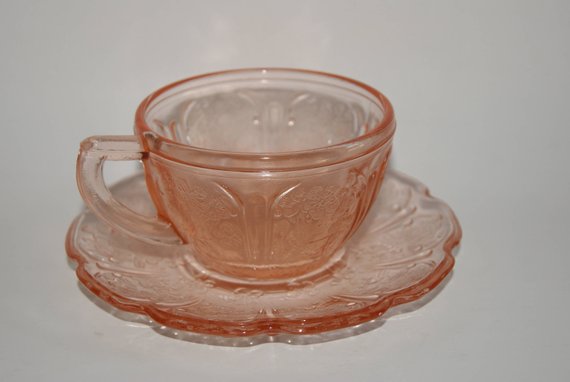
One cup and saucer set that you could run across is this great Depression Glass example.

As you can see, it sports the CHERRY BLOSSOM pattern and is by the Jeanette Glass Company.  It was made from 1930 to 1939 and can be found in my Etsy shop here.

Hand painted examples are always fun for me, you will never find two that are exactly alike.  One cup and saucer set that fits in this area is this one by NAPCO Pottery.

This set features a yellow floral motif, and it dates to the 1950’s.  You can see it in my Etsy shop here.

Wedgewood also made several examples, and one such example is this terrific Mulberry handle less cup and saucer from the 1800’s.

It sports the WASHINGTON VASE pattern, and you can see it in my Etsy shop here.

There are quite a few ways that you can collect cups and saucers.  Not only can you collect cups and saucers by the pattern that is on them or the manufacturer, you can also find examples that could go with a certain color combination that is in your house or apartment.

You can see all of the cups and saucers in my Etsy shop here.  Head on over and check them out!

A little Lefton Pottery history

George Zoltan Lefton was a Hungarian-born sportswear manufacturer, and he had a big passion for collecting fine porcelain.  From 1945 through 1953, the Lefton pottery company was importing many things from postwar Japan including (but not limited to) head vases, figurines, cookie jars, and salt and pepper shakers.

These items are marked “Made In Occupied Japan,” and the figures even sport a red and gold paper label that read “Lefton’s Exclusives Japan.”

Lefton contracted pottery companies around the world to produce ceramic items for Lefton.  These items are just as diverse as what they imported.

One of these really cool items that was imported is this 25th Anniversary Plate.

The silver decorator plate dates to the 1970’s and can be seen in my Etsy shop here.  Another item that shows how diverse Lefton is this great nappy.

You can see the nappy in my Etsy shop here.  As a matter of fact, you can see all of the Lefton pieces in my shop here.  Head on over and check them out!