What you need to know when you set up an antique booth

You start to look around the house and you notice that you have quite a few things that you have collected that you now want to sell.  You know that the items are too expensive for a garage sale, and you don’t have the time to list the items for sale online.

What do you do now?

A booth in an antique mall or a flea market is a wonderful way to help you make some money and clear out some of those things that you have around the house.  There are some things that you need to know before for jump into renting a booth.

The first thing you need to do is to find the perfect place for you to set up a booth at.  This could be at a place that you love to shop at or even heard of.  The best thing to keep in mind is to see if that place has a pretty good amount of foot traffic going through it.  This will help you have more potential sales.

Another thing you need to know is if the antique mall or flea market requires you to stay a certain amount of time.  It’s rare for this to happen in the area that I live in–you can shut down the booth after just one month if you want to.

More often than not, you will need to pay for your first month’s rent on the booth.  I’ve seen the rent cost anywhere from $35 for a small booth or showcase all the way up to $300 for a large booth.

The place that you want to rent a booth at may charge you a commission on every item you sell.  You need to ask if they do, and even how much the commission is (I’ve seen it around 10% of the selling price of the item).

You might be able to opt out of the commission; the mall might charge you a little more on the rent of the booth to cover this commission.

The mall will require you to have a number—this will help the mall separate out who sold what.  This will be done the day that you set up the booth, but don’t worry—the mall will have a list of what numbers the other dealers have so there is no confusion.

A word of advice—look to see what kind of tags the dealers are using (a piece of tape may not be wanted at the mall).  One thing that I have seen a lot of is a piece of paper cut into a small square tied on with twine or ribbon.

Good luck and lots of sales to you!

What are some of the benefits of getting an item appraised?

You have a piece of jewelry from your grandmother, your dad’s vintage comic book collection from his youth, or even a piece of furniture that you picked up at an antique mall.  You know that the piece has value, and you are not sure if you want to get an appraisal on it.

What are some of the benefits of getting an item appraised?

There are several benefits when it comes to getting an appraisal.  The first reason (and probably best) is that it helps tell you the value of the item that you have.

The second reason is that it helps clear up any confusion on what the item is.  You could have heard several stories from the family, and each story identifies the item (or items) completely differently than what it actually is.

Another reason is that the appraisal helps you know if your item is real or not.  A good rule of thumb is to try to find someone who appraises items on a regular basis like what you have.  This will help with both the value and authenticity of the piece that you have.

When it comes to jewelry, the appraiser has equipment that helps determine what the types of stones that you could possibly have.

Another good benefit on appraisals is that you could also get everything written out telling what the item is.  This will also help with insurance (if it’s needed on the item).

What other types of benefits have you run across when you got an appraisal on an item you have?

Look at all the assorted colors that glass has been produced with!

When you look at the area of glassware, you will see many different colors and finishes that the glass was made with.  There are as many distinct color combinations as there are manufacturing techniques.  Here’s a few of them that you will most likely run across:

Cased Glass—this is glass of one color that has been covered with one or more layers of assorted colors. The outer layers are then acid-etched, carved, cut, or even engraved to produce a design.  This design will stand out from the background, and will have a kind of raised motif when done. The first cameo glasses were made by the Romans in ancient times, and the genre was revived in England and America (to a lesser amount) in the late 19th century.

Flashed Glass—this is glass that has one color with a very thin applied color on the outside (like crystal glass that has a cranberry color applied to it).  This technique is accomplished by applying a chemical compound to the glass and then re-firing the piece to bring out the desired color.  Flashed glass is often used for etched glass (the flashing will be applied after the etching is completed).

Gilding—this is the process of decorating glass using gold leaf, gold paint, or even gold dust. There are examples that have the gilding applied with mercury (it’s called Mercury Gilding.  It’s rarely done today due to its toxicity).  The gilding is then usually attached to the glass by heat.

Peachblow—this is a type of Art Glass made by quite a few American factories in the late 1800’s.  Most Peachblow glass has a coloring that shaded from an opaque cream to pink (or even red), sometimes even over an opaque white.  There was a similar glass that was made in England (it was by Thomas Webb & Sons and even Stevens & Williams).

This is only a small sampling of what has been made.  What kinds of colored glass have you run across?

What exactly is the ART DECO style?

You hear the phrase ART DECO quite a bit in the world of antiques, but what exactly is it?

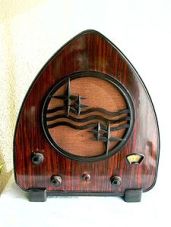
Art Deco got its start in France just before World War 1, and the style ran from about 1910 to about 1939.

Philips_930
Photo courtesy of Wikipedia

People also call Art Deco just Deco, and it’s short for Arts Decoratifs.  It combined several assorted styles—it was influenced by the lines of Cubism, the bright colors of Fauvism (this was a painting style) and even exotic styles from Asia.  Persian, Egypt styles and even Maya art had some influence on the Art Deco style.

club chair
Photo courtesy of Wikipedia

Its influence could be seen on just about everything—buildings, furniture, jewelry, cars, fashion, trains and even everyday items like toasters.

You can see the style around today—you can see it on buildings like the Chrysler Building in New York.

chrysler building
Photo courtesy of Wikipedia

And you can even see it on the Prometheus Statue in Rockefeller Center in New York.

prometheus

Photo courtesy of Wikipedia

What are some things to remember when you go shopping for antiques?

Whenever you go shopping for antiques, there are always a few things that you need to remember.  The first thing that you need to keep in mind is what kind of budget that you have.  What I do so that I don’t go over my budget is to write down on a piece of paper how much my bill will be.

Another thing to remember is to keep an idea (or even a list) on what you are looking for.  It could be a lamp for your living room, a carburetor for your Indian motorcycle or even a Morgan dollar for your coin collection.  I often look in reference books or on the internet to see how much the item that I am looking for will cost so that I know what to expect to pay.

The next thing that I do is to figure out where I would like to go.  You may have several antique stores, flea markets and even swap meets that are pretty close to home, so you could hit several of them in one day.

The last thing to do is to throw a box or a sack into your car or truck.  It might sound silly, but I have one when I go shopping—you may be at something like a garage sale or even a swap meet and need to pack something in it.

The best rule of thumb of all is to have fun!

What are some things to consider when it comes to restoring an item?

When do you restore an item?  Do you leave it well enough alone or do you restore it?  These are questions that you will hear when you are dealing antiques and collectibles, and it can be kind of hard to know what to do.

The first thing to know is how much the item is worth—both in its current form and what it will be worth after the restoration.  An effective way to do that is to get an appraisal on the item.  Ask the appraiser to give you an appraisal on both before and after values to see if it is worth it to restore the item.

If the item’s value will go up after the restoration, you need to keep in mind on what the item is.  If it’s something that you don’t feel comfortable restoring yourself (like a rug or a painting), then you will need to find a good conservator to help you out.

Be careful though—restoring an item could get to be a very expensive proposition.  I’ve seen restorations go from as little as $500 (for a painting) to well over $50,000 (for a car).  To help figure out what it will cost to restore your item, I would contact people who do restorations to get an estimate on what to expect.

The last thing to consider is if you want to do the restoration or to just do a few simple repairs to the item—after all, all the item may need is a good cleaning and one or two new items on it.

The auction that you attended is over. Now what?

The auction that you attended is now over, and you have everything that you bid on and won during the auction packed up.  What exactly do you do now?

The first thing that needs to be done is to pay for what you bought.  More often than not, you will pay for everything at the same place that you got your bidder’s number.  The person that assigns you your bidder’s number gets a sheet from the auctioneer that states what was sold and for how much it went for.

This sheet will be separated out by the bidder’s number written down on it so they can have all the buyers pay for the right items.

After you pay, you now get to take everything home and make any repairs if there are any to be made.  Once that’s done, you now get to take the items to your booth, list them online for sale, or even add them to your collection.

You can see what to do when you first arrive at an auction here.  What kinds of great finds have you run across at an auction?

A portrait plate made by two different companies? How’s that possible?

At a recent sale, I ran across a great portrait plate from the late 1800’s to the early 1900’s.  It has a great motif on the front—a gorgeous lady with a gold trim near the edge that has harps and a floral motif.

Royal Vienna ZEH SCHERZER ZS And Co Porcelain Portrait Plate Artist Signed Gracioga

But when I picked it up and looked at the back, it had two different company marks on it.  The first reads ROYAL VIENNA and the other is Z. S. & Co Bavaria.

Royal Vienna ZEH SCHERZER ZS And Co Porcelain Portrait Plate Artist Signed Gracioga plate

This is pretty interesting—the two marks actually have a purpose.  The ROYAL VIENNA mark is for the hand painted decorations on the front of the plate.  The second mark stands for ZEH SCHERZER & Co., and they produced the ceramic plate.

The ceramic plate was produced and then sold to ROYAL VIENNA undecorated.  When ROYAL VIENNA received the plate, they then painted it with this terrific motif.

Sometimes the artist even signs the piece.  It could be anywhere really—I have seen the signature on both the front and the back of the piece.  This plate was signed on the back, and it was signed Gracioga.

You can see this terrific portrait plate in my Etsy shop here.  Have you ever run across anything like this?

How long is too long to list an item?

One of the questions that you will ask yourself whenever you are selling online can stop you in your tracks—how long is too long to list an item?

From my own personal experiences, you can list the item from one to four months (that’s depending on the site you are on).  These sites will charge you a small fee not only to list the item but to renew the listing as well.  The renewal fees itself can add up pretty fast, cutting into your profits once the item sells.

What I do is I look at the listing to see what I can change—a better description or title and even different pictures can go a long way to help sell the item.  There have been quite a few of the items that I have sold online that I have done these tricks too that help sell them.

The next thing that I do is I look at the price and lower it a little if I feel that will help.  Don’t lower the price too much—it could mean that you would take a loss on it when you make a sale.

I usually don’t let any listing that I have online be renewed more than five or six times.  After renewing that many times, I take the listing down and I will combine it with something else to help sell it faster.  If I have a set of Tupperware measuring cups that looks like they are not going to sell by themselves, I will take that listing down and combine those measuring cups with something like a set of Tupperware measuring spoons.

One other thing that you might want to consider is switching the listing to offer free shipping if your profits are high enough on the listing.

How long the listing is active also depends on what the item is (like a car or furniture) or how expensive it is.  Both may play into how long the listing is active.

What do you do to help sell the items you have up for sale?

Getting out of your comfort zone can be a good thing

When you are buying items to sell either online or in your shop, getting a little out of your comfort zone can be a good thing.

What do I exactly mean by this?  This could be considering an item when you know absolutely nothing about it.  If it’s cheap enough, you could go ahead and buy it so that you can learn something and earn a little of a profit when you sell it.

It could be anything, really.  It could be a book, a piece of Fiesta pottery, a Fenton glassware piece or even an advertising piece.

When I started to sell items, I knew absolutely nothing about clothing (except for what I found at Walmart).  After a while, I had a decent working knowledge of what brand names are out on the market.  Not only that, I now offer a wide variety of clothing from earrings and necklaces to prom dresses and even designer shoes.

So keep an eye out—you may find something today that you can learn from!  What kinds of items have you run across like this?