Weeding out the reproductions

Homeowners this time of year begin to get rid of lawn weeds in hopes of having a lush green yard.  Likewise, shoppers need to learn to “weed out” those items which typically show up on flea market and antique shelves this time of the year.

Weeds are what I like to call reproductions, and they can be quite convincing.

It could be an advertising sign that is rusted and looks to be ever so real.  Damage to the corners, fading to the paint, and even dents are all applied to a brand-new sign to help make it look older than it is.

There’s glassware on the market that copies Depression Glass and art glass patterns.  It is so convincing that the pattern and the color are the spitting image of the old items.  There are some manufacturers that have figured out how to make a piece of glass “glow” in a black light like the old stuff without using Uranium.

Brass imports such as spittoons or candle holders already come with tarnishing.  Wooden boxes and furniture furniture that is hammered, faded and well-used are also plentiful without much looking around.

So, buyer beware and do your homework!  You can never have too much information when it comes to antiques—it always comes in handy.

What’s in a maker’s mark on pottery?

There’s a ton of pottery out on the market that you will run across, but how do you know what’s what?  And how do you read the mark on the bottom of the piece to know what you have in your hands?

Here are a few things to keep in mind when you are looking at a mark:

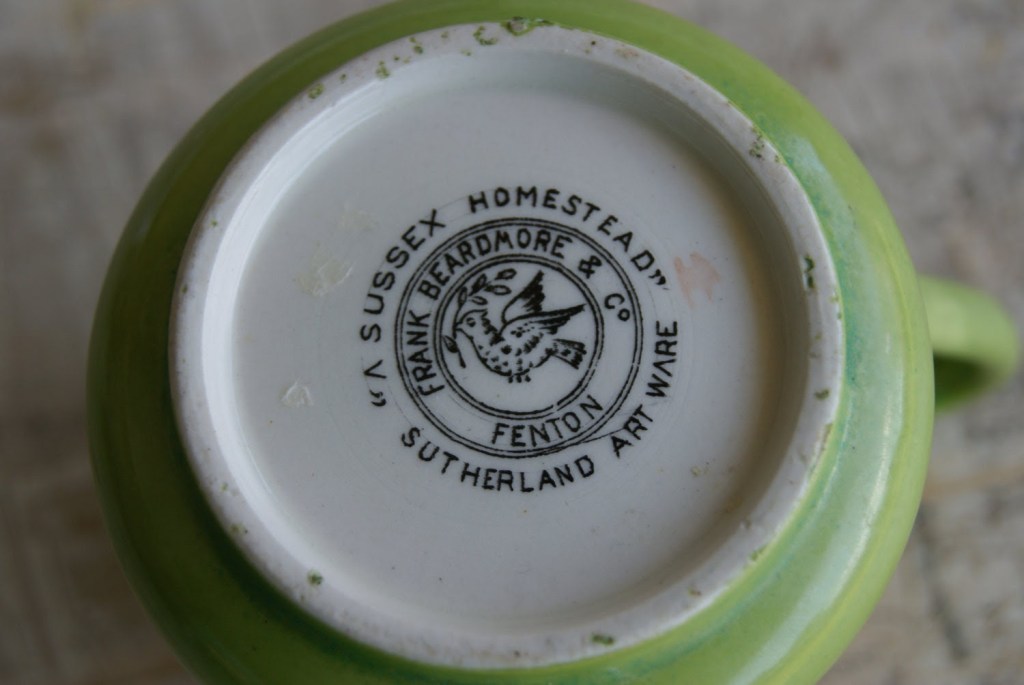
A maker’s mark will run a wide variety on how much information it will give you.  It could be just the name of the name of the company, or it could be loaded with information like the Frank Beardmore piece pictured above.  Since 1891, all pottery that is made to be exported (especially into the United States), it must be stamped with a country of origin near the maker’s label.

With artist’s being hired on by the pottery companies to hand paint some items, the artist could sign their name to the piece as well.  I have seen an artist signature to either the bottom of the piece or on the side of the piece (I would look near the bottom of the piece to see if the artist signed there).

There are times that the name of the pattern is written on the bottom of the piece as well.  The Frank Beardmore creamer’s pattern is called “A Sussex Homeland” and the name of the pattern is listed at the top of the mark on this piece.

A good tip to remember is that the marks on pottery are not that hard to decipher; it just takes about a minute to figure out how the maker laid out the mark.

What kinds of pottery have you found something out by looking at the mark?

What are some places for you to get inventory to sell online?

When you start to sell items online, you will run across a question that could stump you—where can you go to find inventory?  Garage sales, estate sales and even auctions are popular ways to find inventory.  Here are some of the other places that you can go to find inventory:

Church sales are a good place to go because there will be a large amount for you to look at.  Not only that, but there will also be a wide variety of items that you will run across.  This type of sale is usually a fundraiser for something like a mission trip or do raise money to do something at the church, so there is a great chance that the price of the item will be low.

Goodwill is also a great place to go to find inventory.  Not only is there the regular store, but Goodwill also has outlet stores where you can buy it by the pound.  I can’t tell you how many deals I have bought there—it’s one of my favorite places to go.

Moving sales are a lot like going to a garage sale.  The main difference between the two is that a moving sale is where they are getting rid as much as possible so they can move and not take it with them.  There have been moving sales that I have attended where I have seen the seller even give items away.

Going out of business sales are probably overlooked by some.  I have bought everything from tools to sports jerseys and even home decorations at this type of sale, and I have also seen clothing racks, shelves and even light fixtures for sale.  Not only can you get items to sell online, but you can also get what you need to get organized while you sell.

This is a small sample of places that you can go to find inventory to sell online.  What are some of the places that you have gone too to find inventory?

What are some do’s and don’ts when attending an estate sale?

You have decided to go to an estate sale that is near where you live.  You are all ready to go, but what are some do’s and don’t to remember when you attend the estate sale?

Do look everywhere.  This includes the attic, the shed and even the garage—I have found valuable items hiding in weird spots.

Don’t block driveways, other houses mailboxes or even fire hydrants.  The best thing to remember is to be considerate of other people.

Do double check the final tally of your bill before you check out.  This way you have enough cash so you can buy everything that you want.

Don’t shop from the “Hold” area.  During the estate sale, there will be an area near the cash register that shoppers can store their items that they are going to buy.  These items are considered sold, and I have seen people get very protective of the items that are on this shelf.

This is a small list of things to remember when you attend an estate sale.  What are some of the do’s and don’ts that you have heard of for an estate sale?

What a truly odd bird!

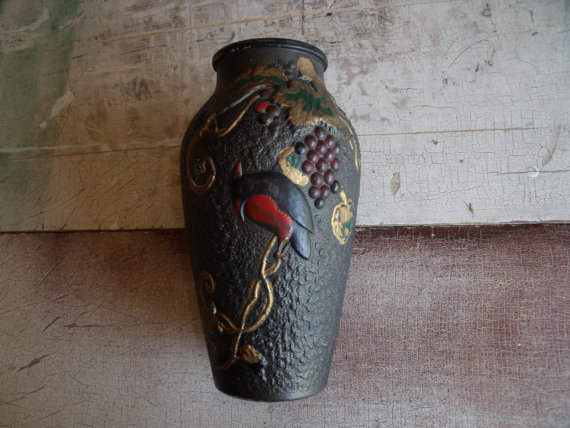
Goofus glass was made in the early 1900’s and was the first type of carnival glass giveaway because it was relatively cheap to make.  Plates, bowls, vases (like the one above), and even oil lamps were made in mass quantities.

The glassware was also made with highly decorative patterns like the one on the vase above.  The pattern on the vase featured here is called, “Odd Bird Sitting On A Grape Vine.”  The bird on the vase looks like it could have come out of a comic book!

The great thing about goofus glass is that it comes in a wide variety of colors form what’s on the vase to red, gold and even green.  With a wide variety of colors and shapes, you could find the perfect piece and color combination for any room.

One thing that you need to keep an eye on is the paint itself.  Since the paint was not fired on, it tends to flake off.  So if you are patient, you will find a piece of Goofus Glass with all of its original paint intact.

Another thing that’s great is that goofus glass can be seen from flea markets to swap meets to even antique stores and shows.  You never know what you’ll find where!

What kinds of patterns and pieces of goofus glass have you found or run across?

A little research can go a long way!

Several years ago, I was shopping at one of the local antique malls that is in the area that I live.  I happened onto something that could be worth some money.  The item that I ran across happened to be a large shaker or even a hat pin holder by R. S. Suhl.

With the price being right (and there being a little wear present on the bottom of the shaker), I went ahead and bought it.  When I went to find out what I could about the mark so that I could list it online, there was a little voice in the back of my head that was saying something was not right.

After a few minutes of searching online, I found a shaker just like the one that I just bought.  I was so thrilled to find it!  I started to read what was posted online about it, and sure enough that little voice was right—the shaker was indeed a fake.

What was the lesson I learned?  A little research and knowledge can go a long way in life.

Have you found something like this that turned out to be a fake after you bought it?

What are some glass terms that you will run across?

Whenever you go out to an antique mall, flea market or even an auction, you will hear some terminology that describes areas of collecting.

Here are a few words that you will run across when you hear people talk about glass:

Frosting—this is a matte finish that is produced by exposing the glass item to fumes of hydrofluoric acid.  This is also a small patch of surface cracks by weathering.

Ice glass—this is a decorative effect that causes the surface of the glass to resemble cracked ice.  This is accomplished by plunging a piece of hot glass into cold water as quick as possible.  This process creates a finish to the glass that resembles cracks.

Luster—this shiny metallic effect is made by painting the surface of the glass item with metallic oxides that is dissolved in acid and mixed with an oily medium.  The item is fired in oxygen free conditions which cause the metal to deposit a distinctive shiny surface after it is cleaned.

Opal glass—this is a glass item that looks like an opal being translucent and white, and it has a grayish or bluish tinge to it.

This is a small look at some of the words that you will hear about glassware.  What are some of the words you ran across?

A buying lesson for the beginning shopper—make sure to check for damage!

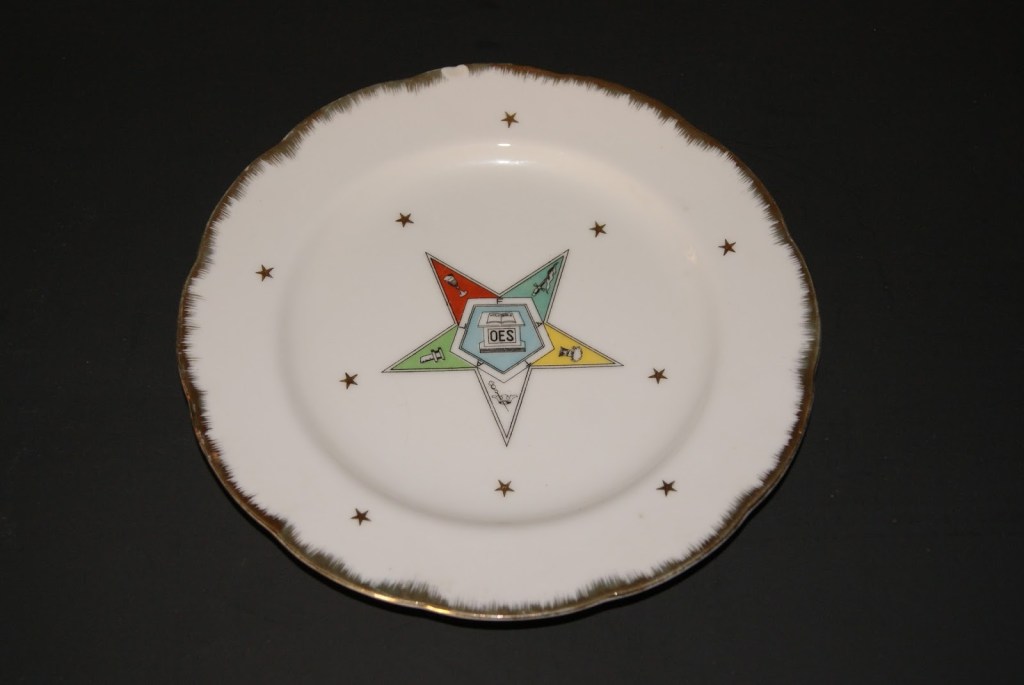
When I was at an estate sale not too long ago, I managed to find some really cool items.  One of the items was a Lefton salad plate made for the Order of The Eastern Star.

I had purchased it under the notion that the plate was in good shape.  When I got the plate home, I found the plate had a chip on the edge of it.

Today when we shop, we have the ability to use our cell phone to check out the worth and rarity of a piece that we are interested in.  To a great extent, it has diminished the need to go with your gut, but not completely.

You still have to be able to judge if in item is fake or real—and frankly to discover the flaws on an item.  You need to use your fingers and the light that is around you to discover chips and even cracks.

Fortunately for me, the purchase price of the plate was inexpensive, it was less than 5 dollars.

What kinds of mistakes have you made when you purchased an item?

Searching The World Wide Web

With a book out on the market on just about any antiques and collectibles area that you could imagine, it would be a safe bet that you could find any item fairly fast, right?

Sometimes it does not work out that way.  The internet can be a great resource for information on the item that you are looking for like this head vase for example.

When I look for something, I start with a broad search by typing in “head vase” in the search bar.  If that does not get me what I need this is when I start typing in specifics.  If the piece has a stamp or a sticker with the makers name on it, I use that.

With you narrowing down the search, you get to the point where you can find the item you have pretty quickly.  It can even get to the point where you can find several listings of the same item as yours so you have a great price range on it.

What kinds of tricks and tips do you use when you search for an item on the internet?

Sometimes directions can help you out in collecting paper money

Directions play a part in quite a few different ways in life, including when you collect paper money from the early 1800’s. During this time, it was up to the banks to produce paper money. The banks would file for a charter with the United States government—this would allow the bank to produce their own paper money.

Collectors often look for paper money in a couple of ways for their collections—and going a certain direction will often help them out. They will look for a certain bank, city or even the state the money was produced in. I have even heard of collectors looking for anything that is west of the Mississippi. You could even look for something in the southern states like Alabama or even Louisiana.

The east coast area has quite a few different banks that offered paper money. This was true up to the Mississippi (the father west you went there were fewer banks to run into). The gold rush in California that started in 1848 was what helped bring some banks (and eventually a United States Mint in San Francisco) that far west.

If there was a major metropolitan area, the more banks were likely to be there. One way to keep things interesting is to only look for banks that were on the east side of town.

Even up north in places like North Dakota, Washington state and even Alaska have very few banks at all. There have been a few bills (collectors also call them “notes”) to turn up for a few banks in these states. For obvious reasons, these are highly sought after.

What cities and states have you seen on this type of paper money?