What are some things to consider when it comes to restoring an item?

When do you restore an item?  Do you leave it well enough alone or do you restore it?  These are questions that you will hear when you are dealing antiques and collectibles, and it can be kind of hard to know what to do.

The first thing to know is how much the item is worth—both in its current form and what it will be worth after the restoration.  An effective way to do that is to get an appraisal on the item.  Ask the appraiser to give you an appraisal on both before and after values to see if it is worth it to restore the item.

If the item’s value will go up after the restoration, you need to keep in mind on what the item is.  If it’s something that you don’t feel comfortable restoring yourself (like a rug or a painting), then you will need to find a good conservator to help you out.

Be careful though—restoring an item could get to be a very expensive proposition.  I’ve seen restorations go from as little as $500 (for a painting) to well over $50,000 (for a car).  To help figure out what it will cost to restore your item, I would contact people who do restorations to get an estimate on what to expect.

The last thing to consider is if you want to do the restoration or to just do a few simple repairs to the item—after all, all the item may need is a good cleaning and one or two new items on it.

What are some things to consider when you attend an auction?

When you are attending an auction, you need to be aware of what’s going on—especially when you go to pay for the items you bid on.  There are some things to consider, and it could potentially add quite a bit to your bill.

The first thing to consider is that there could be sales tax added to the bill.  The amount of tax really depends on the state that the item was bought in.

Another thing to consider is that the auction house might have added fees when you buy there.  I’ve seen these fees range from 10% all the way up to 30% of the final auction price.

I have seen auction houses have an auction in a certain location and allow bidders overseas to bid on an item.  If you buy an item that’s overseas (especially in Europe and India), there could be restrictions and laws that prohibit you from shipping the item to the United States.

If it’s possible to ship an item from overseas, not only will you have to pay to ship the item, you could also need a special license to ship it here.  One country that I know of that states you have this license is Spain (and it could take a couple of months to get your item).

Another thing to consider are Paypal or credit card transaction fees, which can quickly be racked up on how much you buy.

So, when buying at an auction, it always pays to do a little homework on what is going on.  If you still have questions about something, it also pays to ask questions.

What kind of taxes and fees have you run across when you went to buy an item?

You can relive the 1980’s with this great outfit!

Every once in a while, you can find an outfit that screams of a certain era.  Poodle skirts from the 1950’s and bell bottom jeans from the 1960’s are just two examples when you think of this.

Another item that screams of an era is this great top and skirt from the 1980’s.

kiss pattern dress

KR of NY produced this wonderful two piece outfit with a peplum top and a matching skirt.  What I like about it is the kiss (or even lip) pattern that is on both pieces.

kr of ny

The good thing is that the outfit can be worn to just about any occasion–a party, a night out on the town, or even to a wedding.  Just get yourself a great 1980’s purse and you are set!

You can see this great outfit in my Etsy shop here.  Head on over and check it out!

Terms to help new collectors of pottery

When I started to buy and sell pottery, there were some terms that I picked up pretty fast that I use quite often.  These terms are pretty common and help describe the manufacturing process of the piece.  Here’s some of the terms:

Pinholes—these are faults in the surface of a ceramic body (or even the glaze) that resemble pin pricks.  These are not very big at all, and there is usually no other damage around them.  Air bubbles are the most common culprit that causes these.

Bloating—this is the permanent swelling of a ceramic piece during the firing in a kiln.  It’s caused by the expansion of gases like air not being able to escape out of the piece.

Iron oxide—this is a common oxide in glazes and some clays that generally gives the item a reddish color.

Biscuit pottery—this is also called Bisque pottery.  This is pottery that has been fired, but no glaze has been applied to the piece.

This is only a few of the terms out there.  What have you heard?

The auction that you attended is over. Now what?

The auction that you attended is now over, and you have everything that you bid on and won during the auction packed up.  What exactly do you do now?

The first thing that needs to be done is to pay for what you bought.  More often than not, you will pay for everything at the same place that you got your bidder’s number.  The person that assigns you your bidder’s number gets a sheet from the auctioneer that states what was sold and for how much it went for.

This sheet will be separated out by the bidder’s number written down on it so they can have all the buyers pay for the right items.

After you pay, you now get to take everything home and make any repairs if there are any to be made.  Once that’s done, you now get to take the items to your booth, list them online for sale, or even add them to your collection.

You can see what to do when you first arrive at an auction here.  What kinds of great finds have you run across at an auction?

A portrait plate made by two different companies? How’s that possible?

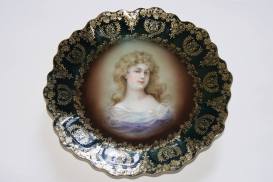
At a recent sale, I ran across a great portrait plate from the late 1800’s to the early 1900’s.  It has a great motif on the front—a gorgeous lady with a gold trim near the edge that has harps and a floral motif.

Royal Vienna ZEH SCHERZER ZS And Co Porcelain Portrait Plate Artist Signed Gracioga

But when I picked it up and looked at the back, it had two different company marks on it.  The first reads ROYAL VIENNA and the other is Z. S. & Co Bavaria.

Royal Vienna ZEH SCHERZER ZS And Co Porcelain Portrait Plate Artist Signed Gracioga plate

This is pretty interesting—the two marks actually have a purpose.  The ROYAL VIENNA mark is for the hand painted decorations on the front of the plate.  The second mark stands for ZEH SCHERZER & Co., and they produced the ceramic plate.

The ceramic plate was produced and then sold to ROYAL VIENNA undecorated.  When ROYAL VIENNA received the plate, they then painted it with this terrific motif.

Sometimes the artist even signs the piece.  It could be anywhere really—I have seen the signature on both the front and the back of the piece.  This plate was signed on the back, and it was signed Gracioga.

You can see this terrific portrait plate in my Etsy shop here.  Have you ever run across anything like this?

It’s a WORLD ON WHEELS!

world on wheels

When you start to collect trading cards, there are two main areas that they are divided into.  The first is sports trading cards, and these feature cards from all the different types of sports–hockey, baseball, golf and football are just a few of the sports.

The other main area is what’s called non sports cards.  This area is everything that does not fall into the sports category.  There are sets that consist of birds, movie stars (and even movie themselves), radio stars, and even vehicles.

The non sports card area is where you find this great set called the WORLD ON WHEELS.

The TOPPS card company produced this card set, and the WORLD ON WHEELS set ran from 1953 to 1955.  The set consists of 180 cards, and numbers 1 through 170 can be found with a red back.  Numbers 171 through 180 can be found with both a red back and a blue back.

Interestingly, a set title of just WHEELS was on the packaging, but the name WORLD ON WHEELS has caught on over the years.

This set has a wide variety of vehicles on the cards, and they really are all over the place.  There are cars from the early 1900’s like a Pierce Great Arrow Touring Car from 1905 all the way to the cars from the 1950’s like a Hudson Wasp from 1953.

It’s not just just cars that are featured in the set, there are vehicles like the Diamond T concrete mixer and the Straddle Lumber Truck.

What I like about the set is that when you get done finding all the cards is that you can say that you have assembled a massive 180 car collection!

You can see some of the WORLD ON WHEELS cards in my Etsy shop here.  As a matter of fact, you can see all of the cards in my Etsy shop here.  Have you ever run across anything like this?

How long is too long to list an item?

One of the questions that you will ask yourself whenever you are selling online can stop you in your tracks—how long is too long to list an item?

From my own personal experiences, you can list the item from one to four months (that’s depending on the site you are on).  These sites will charge you a small fee not only to list the item but to renew the listing as well.  The renewal fees itself can add up pretty fast, cutting into your profits once the item sells.

What I do is I look at the listing to see what I can change—a better description or title and even different pictures can go a long way to help sell the item.  There have been quite a few of the items that I have sold online that I have done these tricks too that help sell them.

The next thing that I do is I look at the price and lower it a little if I feel that will help.  Don’t lower the price too much—it could mean that you would take a loss on it when you make a sale.

I usually don’t let any listing that I have online be renewed more than five or six times.  After renewing that many times, I take the listing down and I will combine it with something else to help sell it faster.  If I have a set of Tupperware measuring cups that looks like they are not going to sell by themselves, I will take that listing down and combine those measuring cups with something like a set of Tupperware measuring spoons.

One other thing that you might want to consider is switching the listing to offer free shipping if your profits are high enough on the listing.

How long the listing is active also depends on what the item is (like a car or furniture) or how expensive it is.  Both may play into how long the listing is active.

What do you do to help sell the items you have up for sale?

The boys of summer…in 1956?

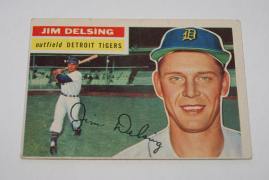
The 1956 TOPPS baseball cards have been a favorite of mine for many years now.  There are quite a few of them in my collection—Jackie Robinson and Al Rosen are just two of them.

1956 topps

When TOPPS came on the sports cards scene in the early 1950’s, they competed with another company named BOWMAN.

When 1956 rolled around, TOPPS bought out BOWMAN.  The wonderful thing that happened for the collectors was that all of the players were featured in just one set.  In the years before 1956, you could only find certain players on BOWMAN cards, while other players were just on TOPPS cards.

Collectors today also look for varieties in the set.  Two of the more famous verities deal the back of the cards with one being called “white back” (this is a white or cream color) and the other is called the “gray back” (this has more of a gray color).

A word of advice though—these cards are a little larger than today’s cards.  Be careful if you want to put these in pages for a three-ring binder (the cards won’t fit).  You may have to buy some pages for these to fit in.

You can also see some of these cards in my Etsy shop here.  Have you ever run into these cards?

At what price do you walk away from a piece?

One of the first questions you ask yourself when you are out shopping for antiques is at what price do you walk away from a piece?  It’s a very simple question that every collector and dealer ask themselves, sometimes even on a daily basis.

It doesn’t matter if you are looking at a piece of pottery, a coin or even an advertising piece.  This question will be asked on pretty much everything that you look at.

A good rule of thumb that I use is I ask myself how much I can actually sell the item for.  I then try to pay half for the item (if I can sell it for $20, I try to buy it for $10).

The reason that I only pay half for the item is that this gives me a good cushion to cover any expenses that I happen to run across.

Some of these expenses that you also have to factor in is the cost of shipping materials like the box, packing peanuts bubble wrap and even tape.  Even the cost of the shipping label also must be considered.

There are also fees that you pay to the selling site whenever you sell an item (you usually will have to deal with these at the start of the month).

When I am looking at a piece, I also look to see if I need to make any repairs or even do something like rewire it or replace parts.  This will definitely drive up the price of the item and eat into (and potentially eat up) any profits that could be made.

What do you consider when you look at the price of an item?