What’s in a maker’s mark on pottery?

There’s a ton of pottery out on the market that you will run across, but how do you know what’s what?  And how do you read the mark on the bottom of the piece to know what you have in your hands?
Here are a few things to keep in mind when you are looking at a mark:

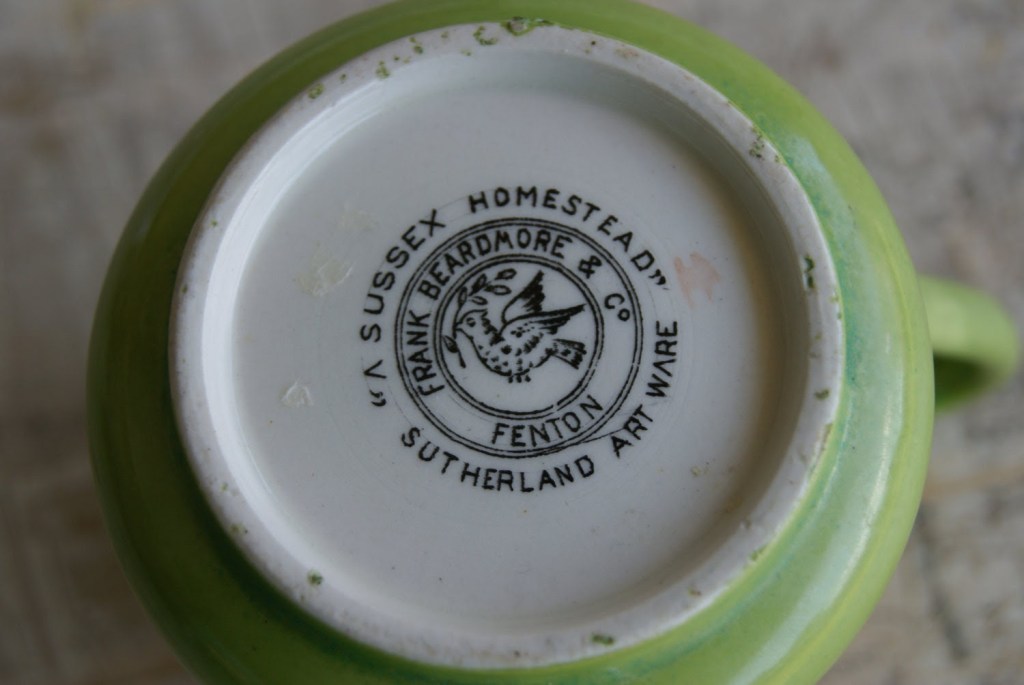
A maker’s mark will run a wide variety on how much information it will give you.  It could be just the name of the name of the company, or it could be loaded with information like the Frank Beardmore piece pictured above.  Since 1891, all pottery that is made to be exported (especially into the United States), it must be stamped with a country of origin near the maker’s label.

With artist’s being hired on by the pottery companies to hand paint some items, the artist could sign their name to the piece as well.  I have seen an artist signature to either the bottom of the piece or on the side of the piece (I would look near the bottom of the piece to see if the artist signed there).

There are times that the name of the pattern is written on the bottom of the piece as well.  The Frank Beardmore creamer’s pattern is called “A Sussex Homeland” and the name of the pattern is listed at the top of the mark on this piece.

A good tip to remember is that the marks on pottery are not that hard to decipher; it just takes about a minute to figure out how the maker laid out the mark.

What kinds of pottery have you found something out by looking at the mark?

What are some glass pieces that you may not use anymore?

Whenever you sit down at the table, you will run across items like saucers, plates and even serving bowls that are made of glass.  What are some of the glass pieces that you may not run across on a modern table?

Epergne—this is a centerpiece that is ornamental, and you will find it on a dining table.  This item is used for holding flowers or fruit.  The horns in the center of it are detachable, and there are examples with as many as 5 horns.

Finger bowl—this is a bowl that has water in it for you to wash off your fingers during a meal.

Cream soup bowl—this is a two-handled bowl.  The reason for the two handles is so you can hold them while you drink the soup instead of using a spoon.

This is a small handful of the pieces of glassware that you may not see on a modern kitchen table.  What are some of the other items like this that you have run across?

A little history of Fiesta Pottery

The pottery line known as Fiesta dinnerware was started by the Homer Laughlin company, and it made its debut in January of 1936 at the Pottery and Glass Show that was being held in Pittsburgh.  Fiesta dinnerware has been produced since then, with a small hiatus from 1972 to 1985.

The reason for the hiatus was the fact that Homer Laughlin actually retired the set.  Collectors started to get interested in the retired pottery, and in 1985 Homer Laughlin was approached by the Bloomingdale’s Department Store to bring it back.  The pottery was indeed brought back, and a new line of Fiesta dinnerware and a new color palate was introduced in 1986 in Bloomingdale’s.

Homer Laughlin originally produced this pattern in Red, Blue, light green, original green, yellow and Old Ivory (Turquoise did not hit the store shelves until 1937).  In the history of the Fiesta dinnerware, there have been a total of 52 different colors in the line.

The great thing about Fiesta is that Homer Laughlin has been known to retire colors along the way.  This gives collectors a totally new way to collect Fiesta—they can now collect their favorite pieces in a retired color.  Homer Laughlin also introduces a new color every year, and it is always fun to me to see what the new color is.

When you start to collect Fiesta pottery, you will see how diverse the set is.  You will see that you can use different pieces in different parts of the house.  Not only that, you can also use one color in the kitchen, one color in the living room and a totally different color in a bedroom.  This gives you a great way to match the colors in the room or to even add a splash of color if you want.

This is a small look at the history of the Fiesta Dinnerware.  What have you heard about the pattern?

What are some do’s and don’ts when attending an estate sale?

You have decided to go to an estate sale that is near where you live.  You are all ready to go, but what are some do’s and don’t to remember when you attend the estate sale?

Do look everywhere.  This includes the attic, the shed and even the garage—I have found valuable items hiding in weird spots.

Don’t block driveways, other houses mailboxes or even fire hydrants.  The best thing to remember is to be considerate of other people.

Do double check the final tally of your bill before you check out.  This way you have enough cash so you can buy everything that you want.

Don’t shop from the “Hold” area.  During the estate sale, there will be an area near the cash register that shoppers can store their items that they are going to buy.  These items are considered sold, and I have seen people get very protective of the items that are on this shelf.

This is a small list of things to remember when you attend an estate sale.  What are some of the do’s and don’ts that you have heard of for an estate sale?

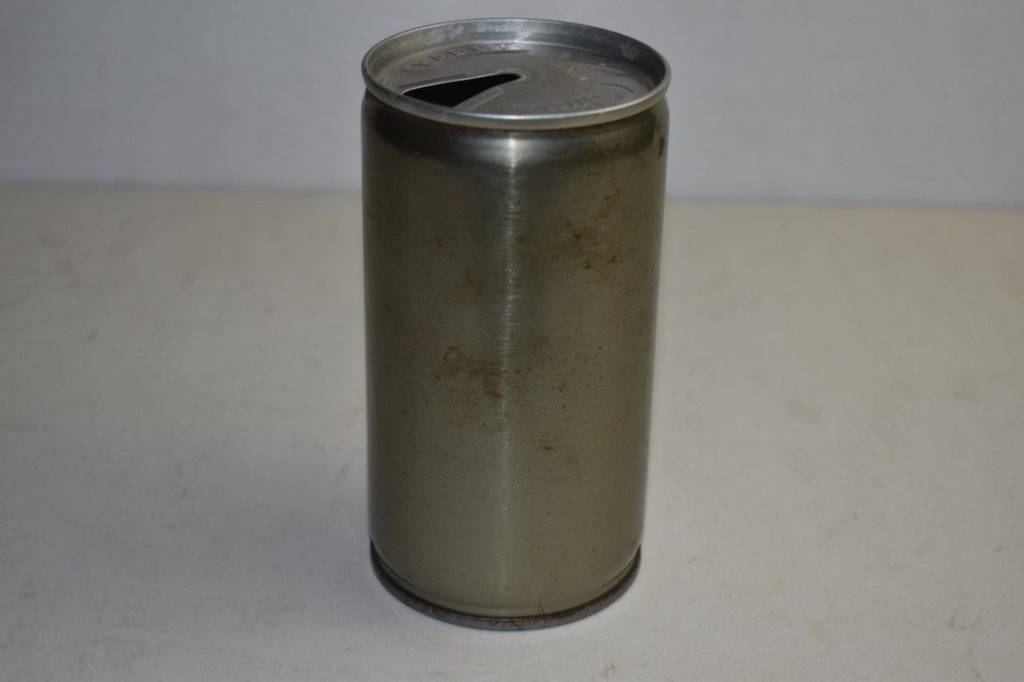
Wow, what an interesting beer can!

The aluminum beer can made it’s debut in the late 1950’s and was introduced by the Hawaii Brewing Company.  Since then, pretty much every brewing company has caught on and started to use them.  Coors, Pabst Blue Ribbon and even Budweiser are some of the products that have been packed into this type of can.

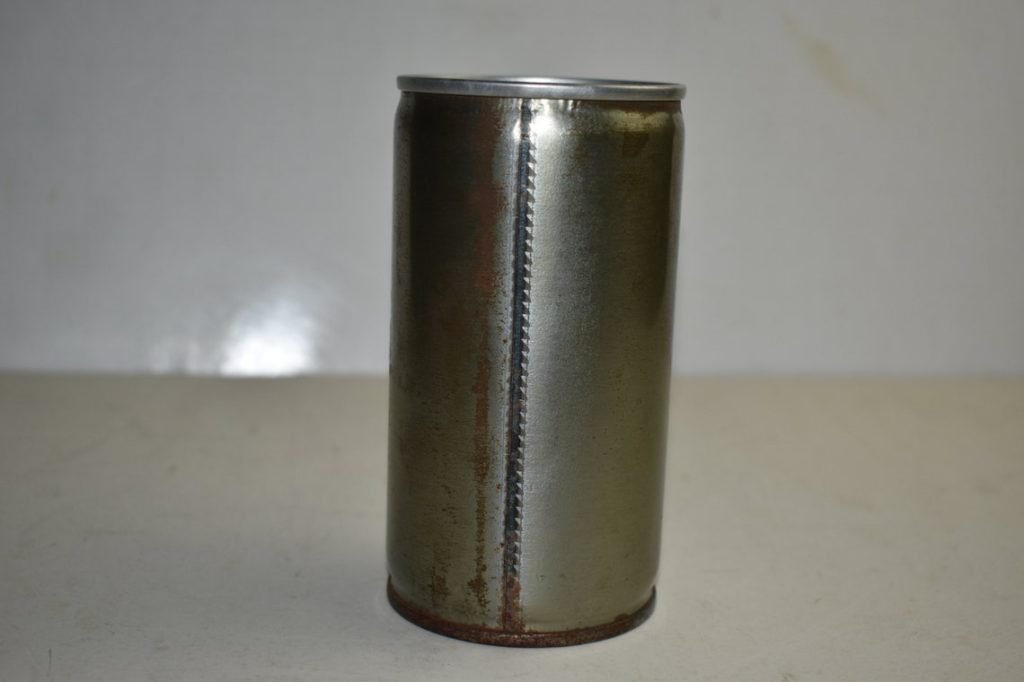
Did you know that there have been errors along the way?  Upside down labels and the lid missing the pop top are common errors, and I bet that I can produce an error that you have never seen—the label on the inside of the can!

As you can kind of see in the picture is that this is a Pabst Blue Ribbon can.  When this can was made, there was a production error that caused the label to be on the inside of the can.

You can also see that there is no damage anywhere to the can, and it can still hold liquid.  The crazy thing about this can is that it is the same size and holds the normal 12 ounces.

You can see this can in my Etsy shop here, head on over and check it out.

I have personally never seen an error like this.  Have you ever run across one similar?

What information is put on a maker’s mark for pottery?

There is a ton of pottery out on the market, how do you know what’s what?  And how do you read the mark on the bottom of the piece to know what you have in your hands?

Figuring out the mark on pottery is pretty easy.  Here are a few things to keep in mind when you are looking at a mark:

*With artists being hired on by the pottery companies to hand paint some items, the artist would sign their name to the piece as well.  Collectors not only collect certain pottery lines, they also look for a certain artist.  A word of advice on this though—if the piece is not signed by the artist on the bottom, then look at the area that is hand painted.  The artist’s signature will not too far away from it.

*The name of the pattern can be on the bottom as well.  The Frank Beardmore creamer’s pattern is called “A Sussex Homeland,” and the pattern is listed at the top of the mark on this piece.  I have seen the pattern name both incorporated into the mark and standing by itself, so keep an eye out for it.

The marks on pottery are not that hard to decipher, it just takes a minute to figure out how the maker wrote it on the piece.

What kinds of pottery have you found something out by looking at the mark?

What a truly odd bird!

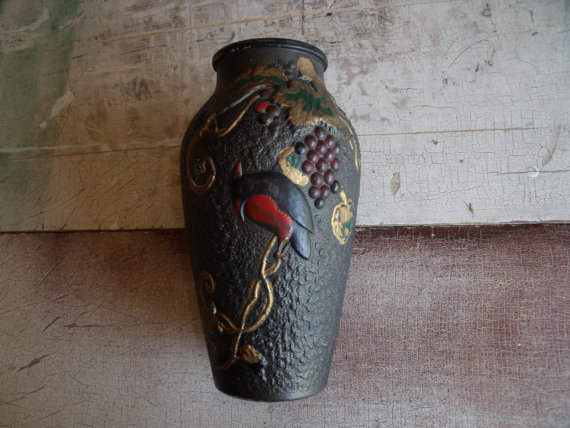
Goofus glass was made in the early 1900’s and was the first type of carnival glass giveaway because it was relatively cheap to make.  Plates, bowls, vases (like the one above), and even oil lamps were made in mass quantities.

The glassware was also made with highly decorative patterns like the one on the vase above.  The pattern on the vase featured here is called, “Odd Bird Sitting On A Grape Vine.”  The bird on the vase looks like it could have come out of a comic book!

The great thing about goofus glass is that it comes in a wide variety of colors form what’s on the vase to red, gold and even green.  With a wide variety of colors and shapes, you could find the perfect piece and color combination for any room.

One thing that you need to keep an eye on is the paint itself.  Since the paint was not fired on, it tends to flake off.  So if you are patient, you will find a piece of Goofus Glass with all of its original paint intact.

Another thing that’s great is that goofus glass can be seen from flea markets to swap meets to even antique stores and shows.  You never know what you’ll find where!

What kinds of patterns and pieces of goofus glass have you found or run across?

A little research can go a long way!

Several years ago, I was shopping at one of the local antique malls that is in the area that I live.  I happened onto something that could be worth some money.  The item that I ran across happened to be a large shaker or even a hat pin holder by R. S. Suhl.

With the price being right (and there being a little wear present on the bottom of the shaker), I went ahead and bought it.  When I went to find out what I could about the mark so that I could list it online, there was a little voice in the back of my head that was saying something was not right.

After a few minutes of searching online, I found a shaker just like the one that I just bought.  I was so thrilled to find it!  I started to read what was posted online about it, and sure enough that little voice was right—the shaker was indeed a fake.

What was the lesson I learned?  A little research and knowledge can go a long way in life.

Have you found something like this that turned out to be a fake after you bought it?

How do you know if the piece you have is truly rare?

One of the words that I hear a lot when I am shopping at a local flea market or even on the internet is the word “rare”.  What goes into labeling an item rare?

The first thing to consider is how many pieces were originally made.  The fewer the items that were made means that there are not as many on the secondary market.

Materials that an item is made of will help drive rarity.  For example, enamelware will have quite a few common items, and one of the collectible areas for enamelware is called “End Of The Day”.  These pieces were literally made at the end of the workday and have at least 3 different colors on them.  The employees that produced this type of item used up the excess materials that were left after a full day’s work.  With this, there will be some interesting color combinations on different pieces.

Another thing to consider is how often an item is used.  This could be a toy that is played with or even a piece of jewelry that is worn.  The more an item is used, the more wear and tear (and even damage) can occur.  It is harder to find an item that is used every day that’s in excellent or even mint shape.

Items like clothing, glassware or even pottery are going to be more fragile.  This will lead to chips, moth holes, cracks, or even rips and tears.  Damage like this will help drive up the price of the good examples.

Handmade pieces also tend to be rare as well.  This is a wide range of items that include autographs, paintings, tramp art, and even furniture.  Because they are handmade (rather than mass produced items), they are one-of-a-kind pieces.  Collectors are often willing to pay more for an item they love that they will never see again!

We all know that plenty of homework helps uncover what items are truly rare!  What kinds of rarities are you on the hunt for?

What are some glass terms that you will run across?

Whenever you go out to an antique mall, flea market or even an auction, you will hear some terminology that describes areas of collecting.

Here are a few words that you will run across when you hear people talk about glass:

Frosting—this is a matte finish that is produced by exposing the glass item to fumes of hydrofluoric acid.  This is also a small patch of surface cracks by weathering.

Ice glass—this is a decorative effect that causes the surface of the glass to resemble cracked ice.  This is accomplished by plunging a piece of hot glass into cold water as quick as possible.  This process creates a finish to the glass that resembles cracks.

Luster—this shiny metallic effect is made by painting the surface of the glass item with metallic oxides that is dissolved in acid and mixed with an oily medium.  The item is fired in oxygen free conditions which cause the metal to deposit a distinctive shiny surface after it is cleaned.

Opal glass—this is a glass item that looks like an opal being translucent and white, and it has a grayish or bluish tinge to it.

This is a small look at some of the words that you will hear about glassware.  What are some of the words you ran across?