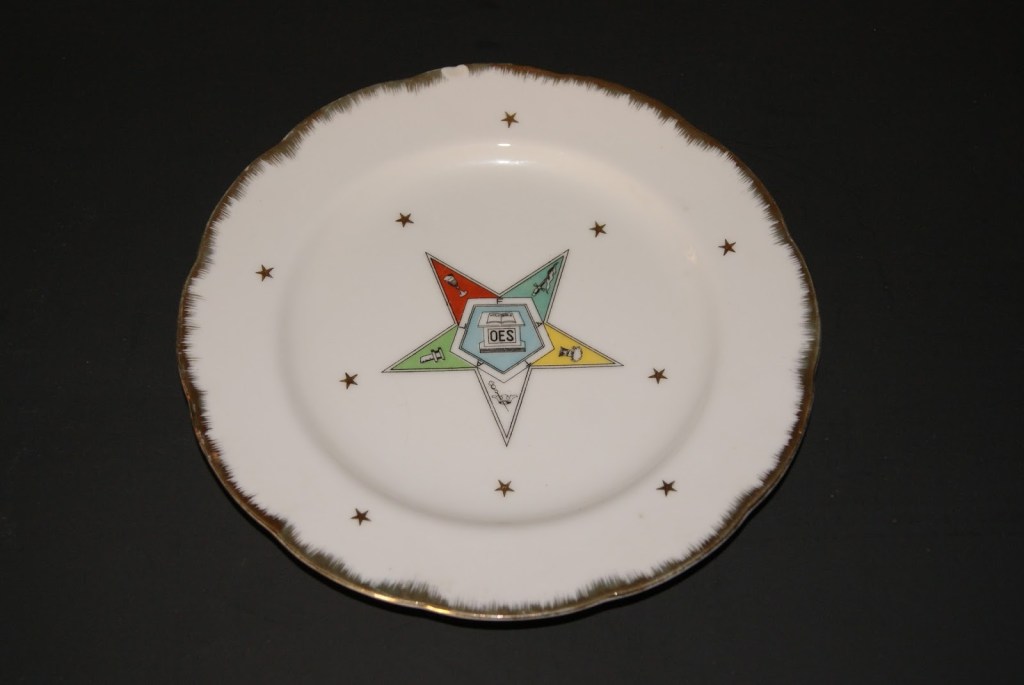
A buying lesson for the beginning shopper—make sure to check for damage!

When I was at an estate sale not too long ago, I managed to find some really cool items.  One of the items was a Lefton salad plate made for the Order of The Eastern Star.

I had purchased it under the notion that the plate was in good shape.  When I got the plate home, I found the plate had a chip on the edge of it.

Today when we shop, we have the ability to use our cell phone to check out the worth and rarity of a piece that we are interested in.  To a great extent, it has diminished the need to go with your gut, but not completely.

You still have to be able to judge if in item is fake or real—and frankly to discover the flaws on an item.  You need to use your fingers and the light that is around you to discover chips and even cracks.

Fortunately for me, the purchase price of the plate was inexpensive, it was less than 5 dollars.

What kinds of mistakes have you made when you purchased an item?

How do you start a collection?

You have made the leap and started to attend some auctions, and you have even gone to antique malls and flea markets in your area.  You might have even gone to thrift stores and even some swap meets.  Then it hits you—how do you go about starting a collection of your own?

The first thing to do is to start a collection on what interests you.  If you love enamelware or even records, the best thing I can recommend is to start there—you never know what kinds of cool pieces you will find.

The second step is to figure out how much of a budget you can afford to spend on your collection.  It does not have to be big at first—over time you will want to expand your budget to help with buying the more expensive items.

You will want to spend time (especially when you first start a collection) on things like how to identify real from fake.  It can be a couple minutes a day worth of research to help you out in the long run.

A good tip to remember is to settle on a fairly wide area to start collecting in—this way you can narrow down the topic of your collection over time.  I have seen people start collecting in an area like coins and then settle on Morgan Dollars and Franklin half dollars.

It’s also perfectly fine to have several collections going on—this way you don’t get burnt out looking for just one topic.

When you start to shop for items to add to your collection, start out at shops, auctions and swap meets where you live.  This way you are not spending a lot of money on getting to where you are going. 

Another thing that you can do is to shop around online.  There have been plenty of times that I have run across items for sale online that are cheap enough that you can add it to your collection.

This is a small handful of tips to help with starting a collection.  What tips have you run across?

Sometimes directions can help you out in collecting paper money

Directions play a part in quite a few different ways in life, including when you collect paper money from the early 1800’s. During this time, it was up to the banks to produce paper money. The banks would file for a charter with the United States government—this would allow the bank to produce their own paper money.

Collectors often look for paper money in a couple of ways for their collections—and going a certain direction will often help them out. They will look for a certain bank, city or even the state the money was produced in. I have even heard of collectors looking for anything that is west of the Mississippi. You could even look for something in the southern states like Alabama or even Louisiana.

The east coast area has quite a few different banks that offered paper money. This was true up to the Mississippi (the father west you went there were fewer banks to run into). The gold rush in California that started in 1848 was what helped bring some banks (and eventually a United States Mint in San Francisco) that far west.

If there was a major metropolitan area, the more banks were likely to be there. One way to keep things interesting is to only look for banks that were on the east side of town.

Even up north in places like North Dakota, Washington state and even Alaska have very few banks at all. There have been a few bills (collectors also call them “notes”) to turn up for a few banks in these states. For obvious reasons, these are highly sought after.

What cities and states have you seen on this type of paper money?

A little history of a Victorian red tomato server

During the Victorian era, you could find a serving piece for just about anything.  Olive forks? Got it.  Cake servers?  Yep, got that too.  But have you ever run across a red tomato server?

These items are great.  Tomato servers come in two different variations, one for red tomatoes and one for green.  Why in the world would you have a different one for each type of tomatoes?  Its simple really when you think about it.  The red tomato servers have the openings built in for all of the juice from the tomato to drain through the server and not onto your tablecloth.

The server for the green tomatoes does not have the openings for the fact that the green tomatoes are not as messy and don’t need the openings.  You could even use the green tomato server for fried green tomatoes.

Currently in my Etsy shop, there is a red tomato server that was made by the William Rogers Company.  Its made of silverplate and sports the LA FRANCE pattern.  You can see the piece here.

The Victorian era truly did make a ide variety of serving pieces for the table.  What items have you run across while shopping?

What are some of the different types of finishes that you will see on glassware?

When you dive into the world of antiques and collectibles—especially glassware—you will find many different types of finishes applied to the item.  Frosted glass, satin glass and even pearlescent glass are a few of the finishes that you will run across.  Here are a few more that you will see:

Matte finish—this type of glassware has a non-shiny finish that was made by sandblasting or even applying an acid to dull the finish of the glass.

Luster—this has a shiny (almost a metallic effect) that was made by applying the glass with metallic oxides that were dissolved in acid and fired in a kiln.  After cleaning, the glass has a distinctive shiny surface.

Acid etched—this is glassware that has been treated with an acid to produce a finish that has a frosted appearance.

This is a few of the different types of finished that you will run across.  What types of finishes have you seen?

What is the difference between collectible, antique and vintage?

There are common questions that you will hear when you dive into the world of antiques.  One of the more questions that you will hear is this—what exactly is the difference between collectible, antique and vintage?

The term collectible is often applied to items that are more valuable than what they originally sold for.  I have also seen this term be applied to items that are newer than 20 years old.

When items are vintage, items in this area are at least 20 years old.  Items are usually considered vintage up until they are 99 years old.

When you hear the term Antique, this applies to items that are at least 100 years old. 

There are also other ways to describe the age of an item.  What terms have you heard?

What exactly is the Hobby Protection Act?


The dime in the picture is from the website of Anti-Counterfeiting Educational Foundation

One of the areas that I love to collect is coins.  Not too long after diving into coins, I heard of something called the Hobby Protection Act.  This had me baffled—what exactly is the Hobby Protection Act and how does it apply to coins?

The Hobby Protection Act was passed in 1973 by the United States Congress.  This act covers imitation political items (like buttons and posters) and even imitation Numismatic items (like coins, tokens and even paper money).

The Hobby Protection Act states that any imitation (or reproduction) political or numismatic item is made, it must be marked a certain way.  When it comes to political items, it must have the year it was made on it with all 4 digits on it.  With coins, it must have the word COPY somewhere on the design.

What is the reason for this act to get created?  The main reason is that it’s to help protect collectors from deceptive reproductions.

So, it pays to look at the design so you don’t over pay for an item.  Have you ever run across a political or numismatic item marked like this?

What are some different types Of Sports Cards?

Think a sports card is a sports card?  Far from it.  There are a ton of different types of cards that you could find.  Here’s a few:

Retail Card—these are cards that are sold to major retailers like Kmart.  The cards will often have the name of the store printed on the card as well.  You might even find a card from a now-defunct retailer.

Insert Card—these are cards that are inserted into packs at a staggered rate (like one card being inserted into every 24th pack).  There is also a number on the back of every sports card.  The number on the back of the insert card will be different than the normal set numbers.  The normal set numbers will appear as 1-400 (or however many cards are in the set), the insert cards will have a number like ST1, or PL1.  When you buy a pack, you never know what kind of insert card could be in there.  There even could be a player who became much more famous later on.

Sell Sheets—these are not cards at all.  They are ads that are sent to distributors for cards that are for sale to the public.  This would show what cards you could get in the set and would show the players that are featured in the set.  You could get these ads from a sports cards dealer for pretty cheap, or even free if the retailer is going to throw them away (it never hurts to ask them if it’s possible for you to have it).  They’re also great to display along with a complete team collection!

So, what’s the rarest card that you’ve ever found?

Whimsies for every type of collector

Glass workers spent their “off” hours after completing their regular work schedule creating unusual glass objects known as whimsies.  This includes candy-striped canes, paperweights, pipes, hats…the list goes on and on.
 

A whimsy can also be an item that is made of a product that you usually don’t see it made out of.  This can be something like a Fenton plate made out of hobnail pattern slag glass.

Whimsies were often taken home and given as gifts to family and friends.  They can rarely be attributed to a specific glasshouse or glass worker.  Some say that color or style indicates region or factory, but no one has come up with a perfect identification key other than to talk to the person that actually made the piece.

Highly collectible and usually pricey, whimsies can be a fun collectible.  What examples have you found?

A lesson learned on reproductions

While shopping at one of the local antique malls in my area, I happened onto something that could be a very good thing. It happened to be an R S Suhl shaker, or even possibly hat pin holder.

With the price being right, and some wear being present on the bottom of the shaker, I went ahead and bought it.  When I went to find out what I could about the mark (so I could list it online), there was a little voice in the back of my head that was saying that something was not right.

And then I found a shaker just like the one that I have.  I was thrilled!  I started to read what was posted online about it, and sure enough, that little voice I was hearing was right.  The thing was a reproduction and possibly even an outright fake.

The lesson I learned?  A little research and knowledge can go a long way in the long run.