What in the world is an encased postage stamp?

In 1862, the United States was smack dab in the middle of a coin shortage.  It was bad, really bad.  Everything was being horded—even the cent was being stockpiled.

An American entrepreneur and inventor by the name of John Gault created something to help with this—the encased postage stamp.

The encased postage stamp is a stamp that was inserted into a small coin-size case.  This case has a transparent front or back. This type of “coin” was circulated as legal tender during periods when coins were scarce.

John Gault was pretty savvy—he saw two ways to make money off of his creation.   The first way was to sell them to businesses and stores that had a high demand for coins.  He sold his encased stamps at 20% of the face value of the stamp.

The second way that he made money was to sell the blank back of the case of the coin as advertising.  There is a minimum of thirty different companies that took up the advertising on the coins.  All of the different companies lend to find some great and different varieties on this type of coin.

Encased postage stamps circulated for about a year (until about the middle of 1863).  This is when the fractional currency released by United States Government became popular enough to help ease the coin shortage.

There were also some other factors that helped bring encased postage stamps to an end.  One reason was was that the postage stamps that were being used for this started to become unavailable.  Not only that, it cost more to buy the encased postage than what they were actually valued at in the market.

Encased postage stamps are rare today with a small fraction of the 750,000 that were originally sold surviving.

This is just one item people came up with over the years to help with coin shortages over the years.  Do you know of any other ways?

What are some of the terms that you will run across when you start to collect stamps?

Not too long ago, I went to a local auction that had quite a few stamps for sale.  There were some stamp collectors and dealers there talking about “changelings” and even an “album weed”.  It made me think—what are some of the terms that you’ll run across when you collect stamps?

Album weed—this refers to a forged stamp, and it also refers to unusual items that resemble postage stamps but were not intended to pay postage.  This is something like publicity labels and bogus issues.

Album Weeds—this is the title of a reference book series that is on forged stamps.  It was written by R.B. Earee.

Changeling—this is a stamp whose color has been changed (either intentionally or unintentionally) by contact with a chemical.  This can also happen with the exposure to a light.

Encased postage stamp—this is a stamp that was inserted into a small coin-size case.  The case comes with a transparent front or back to see the stamp.  These were circulated as legal coins during periods when coins were scarce in the 1860’s.

Handstamp—this is a cancellation or overprint that was applied by hand to either a cover or to a stamp.

Obliteration—there are two main definitions for this term.  The first is a cancellation that was intended solely to deface a stamp (this is also called a killer).  The second is an overprint intended to deface a portion of the design of a stamp (such as the face of a deposed ruler).

This is just a few of what you’ll hear when talking about stamps.  What terms have you heard?

What a great carnival glass plate from Fenton!

When the 1900’s rolled around, a new form of glassware was introduced.  Over the years, it has become to be known as Carnival Glass—and there is a wide variety of manufacturers, shapes and colors.

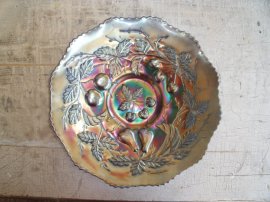
Carnival glass was at the height of its popularity in the 1920’s when Fenton produced this terrific 12-Sided Amethyst Footed Plate with the THREE FRUITS pattern.

3

This terrific item is called a 12-sided plate because of the edge that it has—not only does it have a scalloped edge, it has 12 noticeable segments to it.

The THREE FRUITS pattern that is featured on this plate are cherries, pears, and apples.  Not only is the amethyst color great for just about any room, the pattern will also look great as well.

This great plate can be seen in my Etsy shop here.  What other great carnival glass items have you run across?

Is that early movie star MAE W. MARSH?

Mae W. Marsh was a huge movie star in the 1920’s—going from silent films to talkies.  She made nearly 100 films in her lifetime, and her career spanned 50 years.  Some of these movies include THE LESSER EVIL (1912), THE ESCAPE (1914) and even TIDES OF PASSION (1925).

Mae was a prolific actress, sometimes appearing in as many eight movies a year.  She also became a very popular actress, and she was featured on this terrific plate by STAR PLAYERS PHOTO COMPANY.

Mae W Marsh plate

STAR PLAYERS PHOTO COMPANY produced this fantastic plate in the 1920’s.  This plate with Mae W. Marsh was part of a series by the company that featured other movie stars.  This series had Charlie Chaplin, Anita Stewart, Francis X. Bushman, Marguerite Snow, Alice Brady, Maurice Costello, Lottie Pickford, Lillian Walker and other actor and actresses.

All of the plates in this set features a floral border, and a picture of the star in the center of the plate.  They are also the same size—they are about the size of a dinner plate.

What a wonderful find for the film buff, and you can see this great plate in my Etsy shop here!

A little history for the Goudey Baseball cards from 1933

When 1919 rolled around, Enos Gordon Goudey started a chewing gum company called The Goudey Gum Company.  The company was in business until 1962, and they are known for chewing gum and the baseball cards that they produced.

The company and its gum was so popular that Enos Goudey was called “the penny gum king of America” by William Wrigley Jr. in 1933.

In 1933, the company dove into making baseball cards, and they released a 240-card set.  The set was also called BIG LEAGUE CHEWING GUM, and each pack that was sold came with a stick of gum.

After the set was released, the Goudey Company realized that they did not have a card #106 after collectors sent the company letters complaining that there was no card for that number.

In 1934, Goudey released a card #106, and it featured the retired player Napoleon Lajoie.  In order to get this card, you had to write to the company (they would send you one for a cent).

As you can tell from the photos, the cards had the name of the set at the bottom of the front and a little biography of the player on the back.

You need to be careful when you are out looking for cards for your set.  Since this is a popular set to collect, there are quite a few reprints and fakes of the cards—especially of Napoleon Lajoie, Babe Ruth (Babe was featured on 4 different cards) and even Lou Gehrig just to name a few.

There are many players that are in this set that have been inducted into the Baseball Hall of Fame, so a word of caution is to be taken when you are looking at a card.

Which cards have you run across?

What are the different types of manufacturing for enamel advertising signs?

Just about every area of antiques and collectibles can be divided into several different sub categories.  It could be collecting the denomination or country of origin of coins, a certain glass company or pattern, or even a certain type of manufacturing process like majolica pottery.

This is true for enamel advertising signs, and one of the ways you can do this is the style of manufacturing of the sign itself and how it can be displayed.

The first type is a flat one-sided sign.  This style has advertising on just one side of the sign, and this would be perfect to attach to a wall or the front of a building.  With only one side having the advertising, the back will have just one color of enameling.

The second type is called a flat two-sided sign.  This style has advertising on both sides of the sign, and most of the time this type of sign will be in a stand or frame of some type to help see both sides.

The third type of sign is a flanged two-sided sign.  This type of sign has a built-in 90-degree angled mount on it that allows the sign to come out from a wall or even a side of a building.

The next type of sign is called a curved sign.  This sign will have a curve in it to go around items like a telephone pole, a street light or even the corner of a building.

Another type are gasoline pump signs, and they will advertise the brand of gas that it is.  Not only are there gasoline pump sign examples for automobile gas, there are also some examples known for marine and aviation gas known as well.

The last example is called a neon porcelain sign, and this type has neon lights on it.  This type of sign can light up and you can see the sign better at night, and the most notable type is on a movie theater.  You could also find this hanging in a window of a business.

What types of enamel advertising sings have you run across?