Look at all the different names that coins go by!

When I picked up my first copy of the Guide Book of United States Coins Book by Richard S. Yeoman (this is also called the “red book”), I noticed that there were tons of names and nicknames that coins go by.

It really made my head spin—I had to stop and figure out what was what.  I realized that coins often get nicknames that are more popular than their real name.  Here’s some of the nicknames that you will hear:

Half eagle—this is another name for a United States $5 gold coin.

Eagle—this is a nickname for gold $10 coins that were made up until 1932.  The reason for the nickname is that the coin featured an eagle design on the back.

Trime—this is a nickname for the US three cent coin.  The US mint made this coin in the 1800s.

Double dime—this is a nickname for the 20-cent coin made by the United States mint during the mid-late 1800’s.

Iron dollar—this is a nickname for the US silver dollar from the 1800’s.  The phrase was primarily used in the northeastern portion of the United States, and this phrase was used by people who disliked carrying silver dollars due to their heavy weight.

Mercury dime—this nickname was for the US 10 cent piece that was made between 1916 and 1945.  Even though it was called the Winged Liberty Head dime at the beginning, the name “mercury” dime quickly caught on with the public when it was compared to the Roman god Mercury.

This is just some of the nicknames that you will hear.  Which ones have you heard?
The crazy world of coin collecting and its vocabulary

When I started collecting coins when I was younger, I found out that the crazy thing about it was the vocabulary.  It’s the craziest thing that I have ever heard—there’s about Good and about uncirculated (which are both terms that you use to grade a coin).  There’s even a matte proof, an inverted date, and even a hub.

Here’s some more words that will make your head spin:

Bag mark—these are marks on a coin that occur when coins bump into each other.  This could happen when they are placed in bags at the mint or being moved in the bag. Larger size coins typically exhibit more bag marks than smaller ones due to their size.

Rim—this is the raised edge of a coin that’s created by a machine called the upsetting mill. The idea of a rim is that if the edge on both sides of the coin is raised as high as the design it will help protect the coins design from wear.  This way the coin can be in circulation a little longer without being replaced.

Walker—this is a nick name for the United States Walking Liberty Half dollar.  The design was made between 1916 and 1947, and this is thought by some to be one of the US most beautiful coin designs. The current American Silver Eagles that United States makes have the same design on their obverse.

These are just a few of the terms that I’ve heard over the years.  What have you heard?

Two Cents worth? Yep

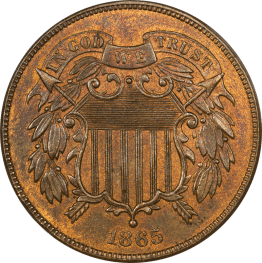
Did you know that there was actually a 2 cent coin that was produced by the United States mint?

The Two Cent piece officially ran from 1864 to 1872, but there was a copy made for collectors in 1873.

The economic turmoil of the American Civil War caused any and all government-issued coins to vanish from circulation, they were hoarded very heavily by the public. Even the Indian Head cent—which was made of bronze—was pretty much gone from circulation.  The Coinage Act Of 1864 authorized the cent to switch to a bronze composition and the production of the Two Cent coin.

800px-1865_two_cent_obverse
Photo courtesy Wikipedia.com

Even though there were other mints actively producing coins in the United States at the time, this coin was only produced at the mint based in Philadelphia.  What this means is that there will not be a mint mark anywhere–which is the way this mint was marking the coins until 1980.

Two of the more famous die varieties happened in 1864.  One is called the “large motto,” and the other is called the “small motto.”  These two varieties deal with the motto, “In God We Trust.”  The words IN, GOD, and TRUST has some small differences, while the word WE has the most differences.  It all hinges on the size of it, and it is very noticeable.  The WE on “large motto” is larger than the WE on the “small motto.”

The “small motto” is much scarcer than the “large motto.”  The best idea is to keep an eye out for it in case you might walk across a case full of coins at a mall, or happen to be at a coin shop or show.

Have you seen one of these really cool coins?

small-motto
Small motto courtesy Wikipedia.com
large-motto
Large motto courtesy Wikipedia.com