Different forms of carnival glass

Carnival glass originated as a glass called ‘Iridill’, produced beginning in 1908.  This was produced by the Fenton Art Glass Company, and the glass quickly caught on.  The 1920’s was the height of the production of carnival glass, and the decade saw huge volumes of glass being produced.

The prices were low enough that everyone could afford, and one of the nicknames that the glass was dubbed was ‘poor man’s Tiffany’.

The keys to its appeal was that it looked a lot like the more expensive blown iridescent glass by Tiffany and Loetz (and others, really).  When the 1950’s came around the name that it has now came about because Carnival glass was often gave away at carnivals.

Today, carnival glass is a fun area to dive into and start to collect.  There are many different forms that you can find.  One such item is something like this vase by Northwood.

northwood

The vase was made in the 1910’s and sports the FINE RIB pattern.  You can see this wonderful vase in my Etsy shop here.  Another form that was made was a plate, like this one by Fenton.

three-fruits

The plate has the THREE FRUITS pattern on it, and it was made during the height of popularity for carnival glass, the 1920’s.  You can see this plate in my Etsy shop here.

Carnival glass was also incorporated into fashion, one example is this bolo tie.

bolo-tie

The slide of the tie features the WINDMILL pattern, and it was made by the IMPERIAL glass company.  The tie was made in the 1930’s, and it would be a fun addition to any outfit!  You can see this bolo tie in my Etsy shop here.

You can see all of the different types of carnival glass in my Etsy shop here.  How many different forms of carnival glass have you run across?
Great Czechoslovakian treasures

Czechoslovakia did not exist until 1918 when World War I ended.  The country was formed as a reward for the help of the Czechs and the Slovaks in winning the war.  It was made up of parts of Austria, Bohemia and Hungary.  In 1993, a peaceful dissolution of the country split it into the Czech Republic and Slovakia.

Items such as highly decorated dinnerware and colorful artistic vases are very collectible because the country was only around for a very short time—only 75 years.

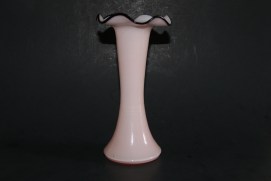
Recently at an estate sale, I discovered one of these great treasures—a light pink 1930’s Czechoslovakia tango glass vase with black trim.

SONY DSC

You can see this absolutely gorgeous vase in my Etsy store here.  What kinds of finds from Czechoslovakia have you found?

More vocabulary words for the glass collector to keep in mind

When you start to collect items in a certain area like glassware, you find out that you need to know some of the terminology when you go along.  Here’s some of the words that I’ve heard over the years about glassware:

Bent (or Slumped) Glass—this is glass that has been heated up in a kiln from room temperature to a temperature high enough to cause it to soften and sag into or even over a mold. The finished product will take the shape of the mold that the glass is around.

Iridescent—this is a surface treatment when a layer of metallic oxide is bonded to the hot glass surface just after the form the glass into a sheet.  The result is a colorful one, and it also has a shimmering effect.

Seedy Glass—this is glass that has air bubbles trapped in it. This is when air or gas is injected into the molten glass prior to forming the sheet causing the bubbles.

What kind of terms have you heard or run across?

Beat the July heat with a Christmas in July sale at Wisdom Lane Antiques!

With this firecracker hot sale, you can get 10% off the purchase price of anything in my Etsy shop by using the coupon code JULYSALE10 (make sure that the coupon code is in all capital letters).  With this coupon code, you will get 10% off the purchase price of any item in my Etsy store.

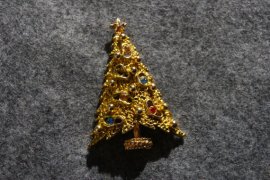
Christmas is probably my favorite holiday out of all of them.  One of the reasons is that you get to wear festive jewelry, like this Christmas tree shaped pin.

Christmas Tree Pin With Multi Colored Rhinestones By ART

The 1960’s pin is by ART and can be seen in my Etsy store here.  Another item that you can wear is this terrific 1980’s dress with a peplum top.

1980s KR of NY Red And White Kiss Pattern Dress Peplum Top Size 5 to 6

This cool dress has a red and white kiss pattern to it and is by KR of NY, and you can see it in my Etsy store here.

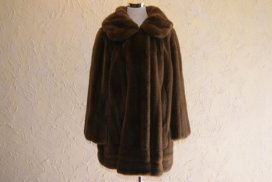
Another item to wear when it gets cold outside is this wonderful (and very warm!) faux fur coat by Tissavel.

Tissavel For Country Pacer Brown Knee Length Faux Fur Coat Or Jacket Long Sleeve 1950s

This coat was made in the 1950’s and was made for Country Pacer.  You can see it in my Etsy store here.

Another reason that I love Christmas is to find someone that perfect gift.  One gift that you can give is this terrific 1980’s black formal dress by BETSY & ADAM.

1980s BETSY and ADAM Black Beaded Crinkle Knit See Through Sheer Top Cut Out Back Detail Knee Length Size 7

It would be perfect for any formal event, or even to wear to the Prom later in the year.  You can see this great dress in my Etsy store here.

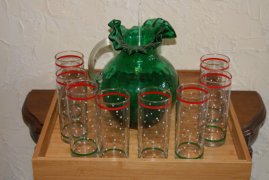
The third reason that I love Christmas is that you get to display pieces that tie into the holidays very easily.  The first item is this great mix and match pitcher and tumblers set.

Mix And Match Lemonade Set Fenton Style Jamestown Green Pitcher With Stir Stick And 8 Polka Dot Tumblers

This set has a Fenton Jamestown Green pitcher and 8 polka dot tumblers, and it can be used to serve your favorite Holiday beverage.  You can see this great set in my Etsy store here.  Another item that can be displayed in your home that ties into Christmas is this wonderful ruby red basket by Fenton.

1970s Ruby Red Fenton Hobnail Basket With Handle And Embossed Fenton Mark On Bottom

This basket has the Hobnail pattern on it, and it could be used to hold potpourri or even your favorite centerpiece on your table.  You can see this basket in my Etsy store here.

Another item that could very easily be displayed in your home at Christmas is this terrific ornament for the Christmas tree.

1982 Strawberry Shortcake A SPECIAL TREAT Christmas Tree Ornament By Americard With The Original Box

This Strawberry Shortcake ornament is dated 1982 and is titled A SPECIAL TREAT.  The great thing about it is that the ornament has the original box with it, you can store it in the box after Christmas is over.  You can see the ornament in my Etsy store here (you can see some more ornaments in my eBay store here).

So beat the July heat with some cool savings in my Etsy store.  All of these and other sizzling deals can be seen here.

What a great way to warm up to the idea of early holiday shopping!

Two simple steps to help spot a real piece of Depression glass from a fake

So you are out at an antique mall, estate sale or even an auction.  While there, you happen to run across a piece of Depression glass.  The piece that you’re looking at doesn’t have any damage on it, but how do you know that it’s the real deal?

When I’m in this situation, I usually use two simple steps to help me determine if the piece is real or fake.  The first thing that I do is to look at the color on it.  There are slight color variations on a real piece, these variations are just going to be a little darker or lighter on the piece.

On a piece of pink Depression glass, a reproduction will more likely have an orange pink hue to it (it’s really obvious).  With a piece that’s green, the reproductions that I have seen tend to go real dark.  I have seen forest green on a piece of ADAM Depression glass.  So if it’s off (especially for the pattern that’s on the piece), it’s a good idea to question it.

The second step that I use is to look at the pattern.  Even though Depression glass was given away quite a bit when it was first made, the glassware still had high quality to it.  What this means is that the pattern is easily recognizable, and there are no missing details to it.  A reproduction may be missing the veins in the leaves of a flower, or the beak on a bird is not as pointed.

A reproduction will sometimes be rushed through, and the pattern will show the crudeness.

So be aware—the fine details will help you determine if the piece of Depression glass will be real or fake.

What kinds of tricks do you use to help determine if you have a real piece of glassware?

Great vocabulary words for the glass collector

Over time, you will pick up quite a few words that describe what a piece is. It could be anything really–there are times when they apply to how a piece is made or what happens to a piece over time. Here are some words that apply to the glassware field:

Chop Plate – this is a large, flat serving plate. This piece is also sometimes called a salver.  You’ll see this type of piece in both pottery and glassware.

Cane –this is a glass rod that’s used in glass making to produce effects like twisted filigree or even marbles.

Sickness – this refers to a cloudy haze that’s in glass vessels such as vases, decanters bottles, and even tumblers. This can be something as simple as hard water deposits (hard water stains can be cleaned off with a little foaming denture cleaner).

So what kind of fun words have you heard?

Here’s some more vocabulary words that new collectors will run across

You never know what words you may run across when you dive into the world of antiques and collectibles.  Here are a couple that I have run across over the years:

Greenware—this is any unfired clay body before the piece is Bisque Fired, and it is very fragile.

Cased Glass—this is two or more layers of different colored glass get blown with one layer over the other.  Sometimes glass makers carve images into the glass, revealing the multiple layers and colors of glass in the process.

Mercury Gilding–this is a technique of applying a gilt finish consisting of gold and mercury to decorative objects like a mirror.  Mercury is a metal that is liquid at room temperature. When combined with gold or silver, it becomes viscous, its consistency becoming similar to that of butter. Mercury gilding is the process in which mercury is mixed with gold to make an amalgam that is applied to the surface of an object.  When the object is heated up by fire, the mercury evaporates away and the gold is left behind.  This is a VERY toxic technique and is illegal to do in many countries.

This is just a small sample of what I have heard, what kinds of words have you run across?