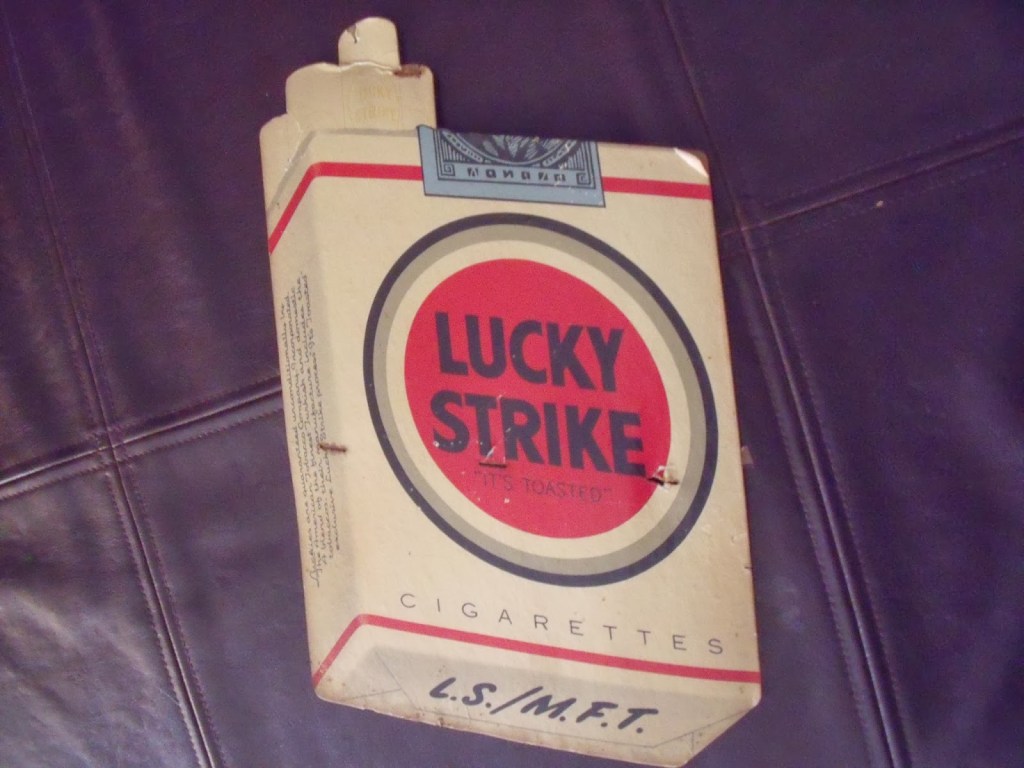
Paper advertising comes in all forms

Advertisers have always relied on colorful product labels, magazine and broadside advertising, and even giveaways to promote their products.  Periodical ads contain colorful product illustrations so that buyers can readily recognize a particular brand and model.

Collecting paper ads is an excellent way to document changing tastes.  Our social and technical history can be traced through the products offered in the ads of the time.

Pries vary with posters and signs being the most expensive.  Bookmarks, trading cards, and magazine ads are often affordable for the beginning collector.

The ads can even be used to decorate around the house.  You could even be creative about it as well; you can display ads for kitchen items in the kitchen and even ads for kid’s toys in a child’s room.

What ads have you run across that you could not do without?

What are some of the things that happened in 1984?

Whenever I look for info on an item that I buy, I try to find out some things about it (like when it was made, the value, etc.).  When I do this, there are times when I run across tidbits of information that happened during a certain year.

I knew that the Summer Olympics and the Louisiana World Exposition were going on in 1984, and there were some tidbits I saw that were really surprising.

On January 24, The Apple Macintosh was released to become the first mass-marketed featuring a graphical user interface and mouse.

May 14 saw the introduction of the one-dollar coin in Australia.

June 6 was the release date of the video game called TETRIS.  This immediately became popular, and the game has been recognized by The Guiness World Records as the most ported game in video game history (it has been on 65 different platforms as of 2011).

Do you know what really surprised me?  The Chrysler Corporation officially debuted the first vehicles that are to be officially labeled as minivans (I thought this one actually happened in the 1970’s!).

This is a small handful of what happened during 1984.  What were some of the things that happened during 1984 do you remember?

What are some photography tips for items that you are selling online?

When it comes to the online selling, one of the first things potential customers will notice is the listings photographs.  What are some tips to remember to help you with getting great pictures that could help you sell your items?

Make sure that the item is clean—there have been plenty of times I have put taking photographs on hold to either give the item a dusting or a complete cleaning.

Get close to the item you are taking photos of.  Getting close up shots of marks, tags and any potential defects go a long way to help you sell the item.

Show how small the item is.  Having a good shot of the item that fills the image can be great, but there will be a time when you need to include something like a ruler to show how small the item truly is.  Another item that I use is an apple to help show the scale—people will have a good idea how big common items like apples or even coins are.

This is a small handful of tips when it comes to taking photographs of the items that you are going to sell online.  What other tips have you run across?

Tips to remember when you are buying inventory

When you are new to the world of buying and selling, you may not know where to buy inventory for your business.  What are some tips to remember when you are out and about looking for deals?

It might sound like I’m pulling your leg, but I keep an eye out for inventory wherever I am.  You never know where you might be when an item might turn up.  I have literally found items that people are giving away by the curb of a street that I have turned around and sold.

Carry pocket change—it can be a life saver.  When the summer rolls around, I throw a couple dollars’ worth of change in my pocket.  It is always welcome by the people running the sale.

Poke around online.  You can find cheap inventory for sale, even with the shipping added in.  You can also look online at websites like Craigslist for items that might be for sale that you could pick up and then sell.

This is just a handful of things to remember when it comes to buying inventory for you to sell.  What tips have you run across?

Stamp vocabulary for the beginning collector

Whenever you start a collection, you will quickly hear some interesting terms and phrases.  There are a ton of them that you will hear, and here are a few of them when it comes to the world of stamps:

Centering—this is the relative position of the design in relation to the margins.  This is one of the important factors when it comes to grade and value.

Pair—this is  two stamps that are still connected and have not been separated.

Dummy stamp—these are officially produced stamps that are imitations of the real thing.  This is to train employees or to test the machines that dispense the stamps automatically.  These are either blank or carry special inscriptions to distinguish them from the real thing.

This is only a few of the terms and phrases that you will hear in the world of stamp collecting.  What have you heard?

Weeding out the reproductions

Homeowners this time of year begin to get rid of lawn weeds in hopes of having a lush green yard.  Likewise, shoppers need to learn to “weed out” those items which typically show up on flea market and antique shelves this time of the year.

Weeds are what I like to call reproductions, and they can be quite convincing.

It could be an advertising sign that is rusted and looks to be ever so real.  Damage to the corners, fading to the paint, and even dents are all applied to a brand-new sign to help make it look older than it is.

There’s glassware on the market that copies Depression Glass and art glass patterns.  It is so convincing that the pattern and the color are the spitting image of the old items.  There are some manufacturers that have figured out how to make a piece of glass “glow” in a black light like the old stuff without using Uranium.

Brass imports such as spittoons or candle holders already come with tarnishing.  Wooden boxes and furniture furniture that is hammered, faded and well-used are also plentiful without much looking around.

So, buyer beware and do your homework!  You can never have too much information when it comes to antiques—it always comes in handy.

What’s in a maker’s mark on pottery?

There’s a ton of pottery out on the market that you will run across, but how do you know what’s what?  And how do you read the mark on the bottom of the piece to know what you have in your hands?

Here are a few things to keep in mind when you are looking at a mark:

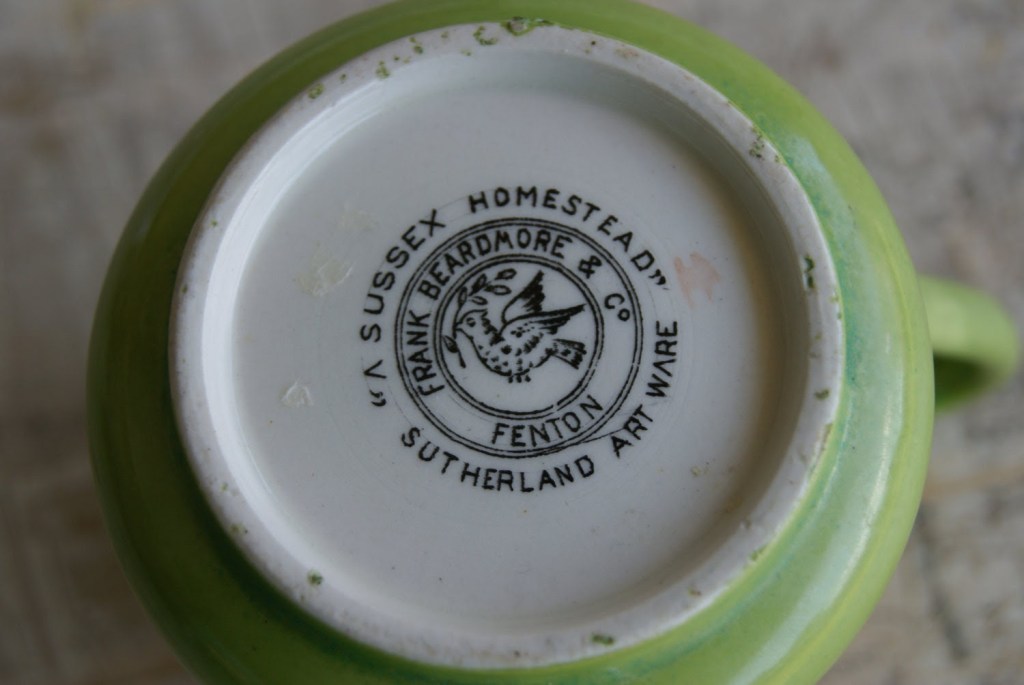
A maker’s mark will run a wide variety on how much information it will give you.  It could be just the name of the name of the company, or it could be loaded with information like the Frank Beardmore piece pictured above.  Since 1891, all pottery that is made to be exported (especially into the United States), it must be stamped with a country of origin near the maker’s label.

With artist’s being hired on by the pottery companies to hand paint some items, the artist could sign their name to the piece as well.  I have seen an artist signature to either the bottom of the piece or on the side of the piece (I would look near the bottom of the piece to see if the artist signed there).

There are times that the name of the pattern is written on the bottom of the piece as well.  The Frank Beardmore creamer’s pattern is called “A Sussex Homeland” and the name of the pattern is listed at the top of the mark on this piece.

A good tip to remember is that the marks on pottery are not that hard to decipher; it just takes about a minute to figure out how the maker laid out the mark.

What kinds of pottery have you found something out by looking at the mark?

What are some glass pieces that you may not use anymore?

Whenever you sit down at the table, you will run across items like saucers, plates and even serving bowls that are made of glass.  What are some of the glass pieces that you may not run across on a modern table?

Epergne—this is a centerpiece that is ornamental, and you will find it on a dining table.  This item is used for holding flowers or fruit.  The horns in the center of it are detachable, and there are examples with as many as 5 horns.

Finger bowl—this is a bowl that has water in it for you to wash off your fingers during a meal.

Cream soup bowl—this is a two-handled bowl.  The reason for the two handles is so you can hold them while you drink the soup instead of using a spoon.

This is a small handful of the pieces of glassware that you may not see on a modern kitchen table.  What are some of the other items like this that you have run across?

What are some places for you to get inventory to sell online?

When you start to sell items online, you will run across a question that could stump you—where can you go to find inventory?  Garage sales, estate sales and even auctions are popular ways to find inventory.  Here are some of the other places that you can go to find inventory:

Church sales are a good place to go because there will be a large amount for you to look at.  Not only that, but there will also be a wide variety of items that you will run across.  This type of sale is usually a fundraiser for something like a mission trip or do raise money to do something at the church, so there is a great chance that the price of the item will be low.

Goodwill is also a great place to go to find inventory.  Not only is there the regular store, but Goodwill also has outlet stores where you can buy it by the pound.  I can’t tell you how many deals I have bought there—it’s one of my favorite places to go.

Moving sales are a lot like going to a garage sale.  The main difference between the two is that a moving sale is where they are getting rid as much as possible so they can move and not take it with them.  There have been moving sales that I have attended where I have seen the seller even give items away.

Going out of business sales are probably overlooked by some.  I have bought everything from tools to sports jerseys and even home decorations at this type of sale, and I have also seen clothing racks, shelves and even light fixtures for sale.  Not only can you get items to sell online, but you can also get what you need to get organized while you sell.

This is a small sample of places that you can go to find inventory to sell online.  What are some of the places that you have gone too to find inventory?

What are a few tips for when you hold your own estate sale?

Whenever you start to buy vintage and collectible items at sales and antique malls, you will eventually come to the point where you will want to sell some of it off.  One of the ways that you can sell some of your items off is with an estate sale.  What are some things to remember when you hold one yourself?

Make sure that you have good traffic flow.  You will want the buyers that come out to look at their own pace, so keep items for sale to both the perimeter and the center of each room.  This way there will be enough room for a couple of people to stand and look at the items without holding up the rest of the shoppers.

Enlist some help.  Have several people at the sale so that they can help with everything from being the cashier to help load the heavy items.  I have seen people bring in some food for the people running the sale to go along with paying them a portion of the sales for them helping out.

Have a plan for the items that did not sell.  This could be donating the items to a local charity or secondhand store that takes donations.  Another thing that you could do is to set them off to the side and you can have items ready in case you have another sale down the road.

This is only a few of the tips for when you have your own estate sale.  What are some others that you have heard of?