A little history of Fiesta Pottery

The pottery line known as Fiesta dinnerware was started by the Homer Laughlin company, and it made its debut in January of 1936 at the Pottery and Glass Show that was being held in Pittsburgh.  Fiesta dinnerware has been produced since then, with a small hiatus from 1972 to 1985.

The reason for the hiatus was the fact that Homer Laughlin actually retired the set.  Collectors started to get interested in the retired pottery, and in 1985 Homer Laughlin was approached by the Bloomingdale’s Department Store to bring it back.  The pottery was indeed brought back, and a new line of Fiesta dinnerware and a new color palate was introduced in 1986 in Bloomingdale’s.

Homer Laughlin originally produced this pattern in Red, Blue, light green, original green, yellow and Old Ivory (Turquoise did not hit the store shelves until 1937).  In the history of the Fiesta dinnerware, there have been a total of 52 different colors in the line.

The great thing about Fiesta is that Homer Laughlin has been known to retire colors along the way.  This gives collectors a totally new way to collect Fiesta—they can now collect their favorite pieces in a retired color.  Homer Laughlin also introduces a new color every year, and it is always fun to me to see what the new color is.

When you start to collect Fiesta pottery, you will see how diverse the set is.  You will see that you can use different pieces in different parts of the house.  Not only that, you can also use one color in the kitchen, one color in the living room and a totally different color in a bedroom.  This gives you a great way to match the colors in the room or to even add a splash of color if you want.

This is a small look at the history of the Fiesta Dinnerware.  What have you heard about the pattern?

What are some do’s and don’ts when attending an estate sale?

You have decided to go to an estate sale that is near where you live.  You are all ready to go, but what are some do’s and don’t to remember when you attend the estate sale?

Do look everywhere.  This includes the attic, the shed and even the garage—I have found valuable items hiding in weird spots.

Don’t block driveways, other houses mailboxes or even fire hydrants.  The best thing to remember is to be considerate of other people.

Do double check the final tally of your bill before you check out.  This way you have enough cash so you can buy everything that you want.

Don’t shop from the “Hold” area.  During the estate sale, there will be an area near the cash register that shoppers can store their items that they are going to buy.  These items are considered sold, and I have seen people get very protective of the items that are on this shelf.

This is a small list of things to remember when you attend an estate sale.  What are some of the do’s and don’ts that you have heard of for an estate sale?

What information is put on a maker’s mark for pottery?

There is a ton of pottery out on the market, how do you know what’s what?  And how do you read the mark on the bottom of the piece to know what you have in your hands?

Figuring out the mark on pottery is pretty easy.  Here are a few things to keep in mind when you are looking at a mark:

*With artists being hired on by the pottery companies to hand paint some items, the artist would sign their name to the piece as well.  Collectors not only collect certain pottery lines, they also look for a certain artist.  A word of advice on this though—if the piece is not signed by the artist on the bottom, then look at the area that is hand painted.  The artist’s signature will not too far away from it.

*The name of the pattern can be on the bottom as well.  The Frank Beardmore creamer’s pattern is called “A Sussex Homeland,” and the pattern is listed at the top of the mark on this piece.  I have seen the pattern name both incorporated into the mark and standing by itself, so keep an eye out for it.

The marks on pottery are not that hard to decipher, it just takes a minute to figure out how the maker wrote it on the piece.

What kinds of pottery have you found something out by looking at the mark?

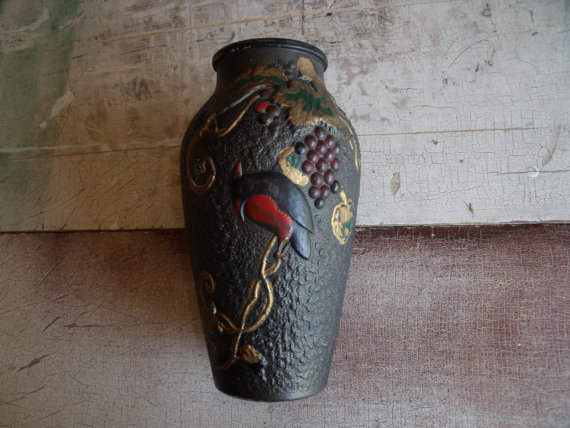
What a truly odd bird!

Goofus glass was made in the early 1900’s and was the first type of carnival glass giveaway because it was relatively cheap to make.  Plates, bowls, vases (like the one above), and even oil lamps were made in mass quantities.

The glassware was also made with highly decorative patterns like the one on the vase above.  The pattern on the vase featured here is called, “Odd Bird Sitting On A Grape Vine.”  The bird on the vase looks like it could have come out of a comic book!

The great thing about goofus glass is that it comes in a wide variety of colors form what’s on the vase to red, gold and even green.  With a wide variety of colors and shapes, you could find the perfect piece and color combination for any room.

One thing that you need to keep an eye on is the paint itself.  Since the paint was not fired on, it tends to flake off.  So if you are patient, you will find a piece of Goofus Glass with all of its original paint intact.

Another thing that’s great is that goofus glass can be seen from flea markets to swap meets to even antique stores and shows.  You never know what you’ll find where!

What kinds of patterns and pieces of goofus glass have you found or run across?

A little research can go a long way!

Several years ago, I was shopping at one of the local antique malls that is in the area that I live.  I happened onto something that could be worth some money.  The item that I ran across happened to be a large shaker or even a hat pin holder by R. S. Suhl.

With the price being right (and there being a little wear present on the bottom of the shaker), I went ahead and bought it.  When I went to find out what I could about the mark so that I could list it online, there was a little voice in the back of my head that was saying something was not right.

After a few minutes of searching online, I found a shaker just like the one that I just bought.  I was so thrilled to find it!  I started to read what was posted online about it, and sure enough that little voice was right—the shaker was indeed a fake.

What was the lesson I learned?  A little research and knowledge can go a long way in life.

Have you found something like this that turned out to be a fake after you bought it?

What are some glass terms that you will run across?

Whenever you go out to an antique mall, flea market or even an auction, you will hear some terminology that describes areas of collecting.

Here are a few words that you will run across when you hear people talk about glass:

Frosting—this is a matte finish that is produced by exposing the glass item to fumes of hydrofluoric acid.  This is also a small patch of surface cracks by weathering.

Ice glass—this is a decorative effect that causes the surface of the glass to resemble cracked ice.  This is accomplished by plunging a piece of hot glass into cold water as quick as possible.  This process creates a finish to the glass that resembles cracks.

Luster—this shiny metallic effect is made by painting the surface of the glass item with metallic oxides that is dissolved in acid and mixed with an oily medium.  The item is fired in oxygen free conditions which cause the metal to deposit a distinctive shiny surface after it is cleaned.

Opal glass—this is a glass item that looks like an opal being translucent and white, and it has a grayish or bluish tinge to it.

This is a small look at some of the words that you will hear about glassware.  What are some of the words you ran across?

A buying lesson for the beginning shopper—make sure to check for damage!

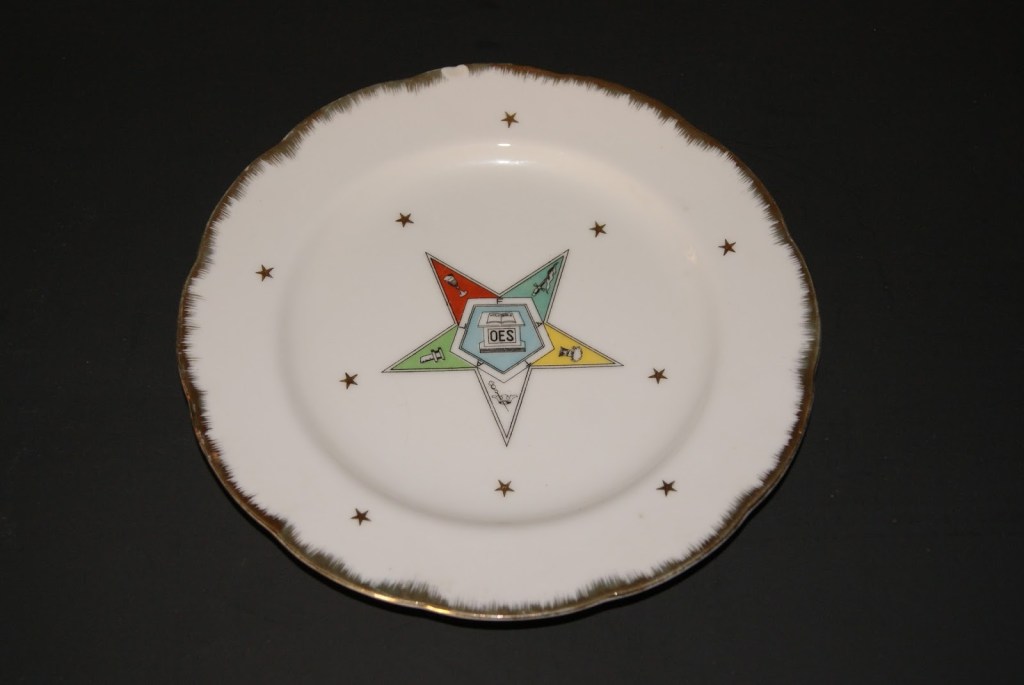
When I was at an estate sale not too long ago, I managed to find some really cool items.  One of the items was a Lefton salad plate made for the Order of The Eastern Star.

I had purchased it under the notion that the plate was in good shape.  When I got the plate home, I found the plate had a chip on the edge of it.

Today when we shop, we have the ability to use our cell phone to check out the worth and rarity of a piece that we are interested in.  To a great extent, it has diminished the need to go with your gut, but not completely.

You still have to be able to judge if in item is fake or real—and frankly to discover the flaws on an item.  You need to use your fingers and the light that is around you to discover chips and even cracks.

Fortunately for me, the purchase price of the plate was inexpensive, it was less than 5 dollars.

What kinds of mistakes have you made when you purchased an item?

Sometimes directions can help you out in collecting paper money

Directions play a part in quite a few different ways in life, including when you collect paper money from the early 1800’s. During this time, it was up to the banks to produce paper money. The banks would file for a charter with the United States government—this would allow the bank to produce their own paper money.

Collectors often look for paper money in a couple of ways for their collections—and going a certain direction will often help them out. They will look for a certain bank, city or even the state the money was produced in. I have even heard of collectors looking for anything that is west of the Mississippi. You could even look for something in the southern states like Alabama or even Louisiana.

The east coast area has quite a few different banks that offered paper money. This was true up to the Mississippi (the father west you went there were fewer banks to run into). The gold rush in California that started in 1848 was what helped bring some banks (and eventually a United States Mint in San Francisco) that far west.

If there was a major metropolitan area, the more banks were likely to be there. One way to keep things interesting is to only look for banks that were on the east side of town.

Even up north in places like North Dakota, Washington state and even Alaska have very few banks at all. There have been a few bills (collectors also call them “notes”) to turn up for a few banks in these states. For obvious reasons, these are highly sought after.

What cities and states have you seen on this type of paper money?

A little history of a Victorian red tomato server

During the Victorian era, you could find a serving piece for just about anything.  Olive forks? Got it.  Cake servers?  Yep, got that too.  But have you ever run across a red tomato server?

These items are great.  Tomato servers come in two different variations, one for red tomatoes and one for green.  Why in the world would you have a different one for each type of tomatoes?  Its simple really when you think about it.  The red tomato servers have the openings built in for all of the juice from the tomato to drain through the server and not onto your tablecloth.

The server for the green tomatoes does not have the openings for the fact that the green tomatoes are not as messy and don’t need the openings.  You could even use the green tomato server for fried green tomatoes.

Currently in my Etsy shop, there is a red tomato server that was made by the William Rogers Company.  Its made of silverplate and sports the LA FRANCE pattern.  You can see the piece here.

The Victorian era truly did make a ide variety of serving pieces for the table.  What items have you run across while shopping?

What are some of the different types of finishes that you will see on glassware?

When you dive into the world of antiques and collectibles—especially glassware—you will find many different types of finishes applied to the item.  Frosted glass, satin glass and even pearlescent glass are a few of the finishes that you will run across.  Here are a few more that you will see:

Matte finish—this type of glassware has a non-shiny finish that was made by sandblasting or even applying an acid to dull the finish of the glass.

Luster—this has a shiny (almost a metallic effect) that was made by applying the glass with metallic oxides that were dissolved in acid and fired in a kiln.  After cleaning, the glass has a distinctive shiny surface.

Acid etched—this is glassware that has been treated with an acid to produce a finish that has a frosted appearance.

This is a few of the different types of finished that you will run across.  What types of finishes have you seen?