Nefertiti and the Whiskey decanter by Michter’s

When 1979 rolled around, a whiskey decanter was released and it featured something different, something that you may not expect to be on a whiskey decanter.  The decanter sports the bust of Nefertiti.

Nefertiti?  Who in the world is Nefertiti you say?  She was a Queen in ancient Egypt and the original bust was found in 1912 and has become one of the more famous artifacts that has come out of ancient Egypt.

It has become so popular that it is featured on items like this decanter from Mitcher’s.  When it was released, there was also another decanter that featured King Tut.

When Mitcher’s made the decanter, they really went all out and put a pretty good amount of detail onto the decanter.  It is also striking with the gold glaze that they put on it as well.

You can see the decanter in my shop on Etsy here.  Head on over and check it out!

What happened in the year 1932?

Whenever I look on the internet or a reference book that I have to look for information on an item that I am about to sell, I will run across really interesting tidbits about what happened during a certain year.

It could be the debut of a product, something that aired on the radio or television or even something that was captivating and held everyone’s interest for a portion of that particular year.

So, what happened during the year of 1932?

May 25—Goofy makes his appearance in the Disney cartoon titled Mickey’s Revue.

August 8—American Gridiron football was a demonstration sport of the Summer Olympics in Los Angles.

October 1—Game 3 of the World Series saw Babe Ruth hit a home run over the center field wall in the fifth inning.  This became to be known as the famous called shot by Babe Ruth.

November 7 saw the debut of the first science fiction show on radio.  It was called Buck Rogers in the 25th Century.

This is just a handful of all the things that happened during the year 1932. What are some of the things that you heard of?

Glassware terms for the beginning collector

When you dive into the world of collecting, you will quickly find that there are a TON of terms that you will hear.  There could be anything from a service set to cheese dishes.

Here are some of the terms that you will run across when it comes to tableware:

Breakfast set—this set features both a sugar bowl and a creamer that match.

Frog—this is an element that has multiple holes in it that hold flowers upright.  This will be in a vase or console bowl, and they range from small to large in size.  They are also in any color from clear pieces to colorful Depression glass and even carnival glass.

Tumbler—this is an everyday drinking glass.  They have been seen both footed and unfooted, and they also run the gambit in color from clear to every color under the rainbow.

Spooner—this item can be mistaken for a sugar bowl since they are similar.  Spooners do not have lids and are taller than sugar bowls since they are designed to hold spoons.

This is a small portion of the terms that you will run across for tableware.  What terms have you heard?

Madrid Depression Glass and its counterpart

The Madrid pattern has been around since 1932, and it is still being produced today.  The name of the pattern has been changed to the Recollection Pattern, and it is made by the Indiana Glass Company.  There are quite a few ways to tell if the piece you are looking at is a piece from the Madrid pattern or is part of the Recollection pattern.

In 1976, the Federal glass company released Madrid as part of their Bicentennial line.  To help discern this from the original, there is a “76” that has been stamped into the mold.  It is easy to spot due to the size of the numbers and that it is often located near the top edge.

The Indiana Glass company released the Recollection pattern starting in the 1980’s.  Some of the pieces that Indiana Glass has released were never produced by the Federal glass Company.  Some of the molds were even put together.  One example is the mold for the candlestick and fruit bowl were put together to produce a kind of pedestal bowl.  If you happen to run across one of these pieces, look at where the bowl joins with the “base”.  If you see some ribbing inside what looks like a hollow area, then this is a modern piece.

The grill plate is different as well.  The original has been divided into three compartments and the newer one only has two.It is amazing how much of both patterns are here in the Ozarks.  Keep an eye peeled when it come to this pattern—you just might be paying good money for a newer piece.

ITEM SPOTLIGHT:  Fenton Grape Leaf pattern pink milk glass from the 1950’s

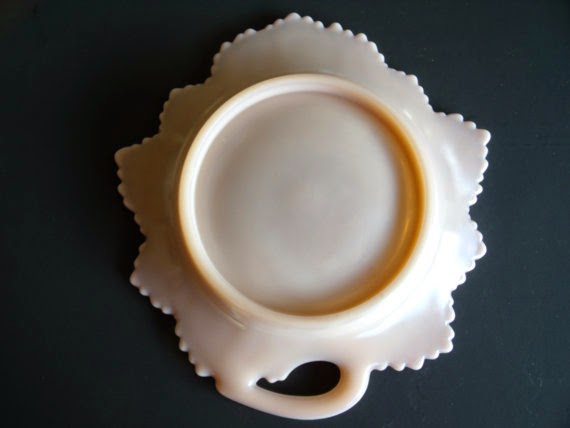
During the 1950’s, the Fenton Glassware company produced many patterns and pieces.  One of the patterns that was produced is called the GRAPE LEAF pattern.  It comes in many colors like white and pink milk glass to name just a few.

The pattern was made for a couple of years, and one of the pieces that was made in this pattern was this footed decorative plate.  You can tell that it was made by Fenton is the fact that some of the pieces were marked on the bottom of the plate.  If it is not marked on the bottom, one of the giveaways that it’s a Fenton piece outside the pattern itself is by the styling of the handle and the edge that is on the plate.

Even though desert, salad or even Buffalo wings are only a small portion of what you can serve on this plate; it was described by Fenton as a decorative plate (so most likely you will see this item displayed on the top of a piano with either candy or potpourri).

What kind of interesting pieces of Fenton Art Glass have you seen?

A little history for the 1925 Broadmoor Polo Association Foxhall Keene Trophy Pitcher

Several years ago, I happened across this wonderful trophy that is in the shape of a pitcher at a local flea market.  When I first saw it on the shelf, I didn’t see the engraving on the side of it.  When I read what it said, I got to wondering about who Foxhall Keene was and what exactly what the Broadmoor was as well.

The first thing to do is to look at the pitcher itself.  It was made by the Wilcox Silverplate Company, and it dates to somewhere between the 1910’s and the 1920’s.  This helps solidify the date that’s on the pitcher, so the next thing to do is to figure out what the Broadmoor was.

Just what was or is the Broadmoor?  The Broadmoor is a hotel and resort that’s located in Colorado Springs, Colorado.  The original hotel is Broadmoor Main, and it was built in 1918.  The resort has had hockey and golf championships, and there’s even polo that is played there.

There’s only one question left for this trophy—who in the world is Foxhall Keene?

Foxhall Keene was quite the competitor.  He was a golfer who competed in the U.S. Open, an amateur tennis player, and he was also a pioneer race car driver who vied for the Gordon Bennett Cup (this was a racing cup that ran from 1900 to 1905 with several clubs racing for it).

Not only did he do all of this, he was also an American thoroughbred race horse owner and breeder.  To top it off, he was a world and Olympic gold medalist in polo.  Not only that, but he was also rated the best all-around polo player in the United States for eight consecutive years.

And that’s where the trophy comes into play.  When the Broadmoor started to play polo at the resort, they named this trophy after Foxhall Keene because he was so accomplished in polo.

It’s always fun for me to find out what the history of a piece is, just like this trophy.  What kinds of finds have you run across that you have found out the history of?

Where are some of the strange places that you have found inventory to sell?

When it comes to finding inventory, the best rule of thumb is to keep your eyes open.  You never know where you will find something—it could be anywhere from the trunk of a Honda to a Church.

One weird place that I got some inventory was a neighbor’s trash can—a person was throwing away a TOMS countertop wire rack.  Another neighbor down the street from me was going to throw away a movie card that I asked if I could have (and I still have it).

Countless sheds, outbuildings and barns have also had many things that I have bought.  Make sure you even check the rafters of these buildings.

There was also the out of business grocery store.  There was a local auction company that was having a sale there—you could still see that the meat department still stocked with its slicer and tables there.  It was interesting to see all of that when I bought a wood Hayward Wakefield table at the sale.

One of the strangest places that I found a piece to sell is a chicken coup—it had a 4-foot tall by 8-foot-long enamel Coca Cola sign inside.

What was the strangest place that I have ever bought something out of?  It was a haunted house that was on the back of a person’s property.

This is a small handful of strange places that I have bought inventory to sell.  Where are some strange places that you have bought inventory at?

What are some things to think about when you are beginning to sell online?

When you are beginning to sell items online, there is so many things to think about.  Here are a few of them that you will run across pretty fast:

One thing to do is to choose a venue to sell on.  Etsy, eBay and Ruby Lane are three of the more popular ones to sell on, but it doesn’t have to be just these.  You could run across a site that works the best for you.

Another thing to think about is what you are going to stock your shop with.  It could be anything from comic books to DVDs to jewelry—it does not matter what it is.

Who pays for the shipping cost of the item need to be figured out before you make your first sale  Free shipping is commonplace now a days, but there will be times that the buyer will need to pick up the cost.

When you get you shop up and running and you have some items listed, you will need to think about how you are going to promote everything.  Will it be by promoting the shop through social media sites or will it be by paying for advertising that is provided through websites like Etsy and eBay?

This is only a handful of items that you need to think about when you sell online, especially when you first start out.  What things have you run across?

ITEM HIGHLIGHT: 1920’s Trident Water Meter by the Neptune Water Meter Company

While I was shopping one day, I happened to see this item.  At first, I didn’t even know what it was—it was so cool that I had to check it out. 

I started looking at it and my mind was blown—and then I saw what the lid had to say.  I saw that the lid states it is the Trident Water Meter by the Neptune Meter Company!

The meter has the original folding cover or lid that covers a white gauge with black lettering, and the gauge reads 10 GALLONS at the bottom.

 The meter is made of either cast iron or brass (the meter has been painted a light blue at some point).  It dates to about the 1920’s and it has very little wear.  An interesting point about this is that the meter is pretty tall at 6 ½ inches—I think that it was being used somewhere like a basement of a house at some point.

Not only is it an interesting conversation piece, but it would also be a fun addition to any mancave or desk.

You can see this terrific item in my Etsy shop here, head on over and check it out!

Paper advertising comes in all forms

Advertisers have always relied on colorful product labels, magazine and broadside advertising, and even giveaways to promote their products.  Periodical ads contain colorful product illustrations so that buyers can readily recognize a particular brand and model.

Collecting paper ads is an excellent way to document changing tastes.  Our social and technical history can be traced through the products offered in the ads of the time.

Pries vary with posters and signs being the most expensive.  Bookmarks, trading cards, and magazine ads are often affordable for the beginning collector.

The ads can even be used to decorate around the house.  You could even be creative about it as well; you can display ads for kitchen items in the kitchen and even ads for kid’s toys in a child’s room.

What ads have you run across that you could not do without?