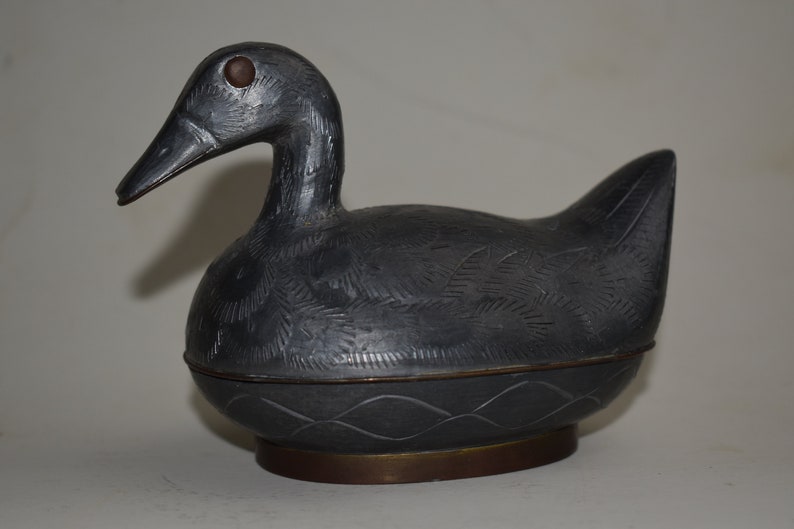
Occasionally, you will run across an item that will make you do a double take. That is what I did when I ran across this dresser box.
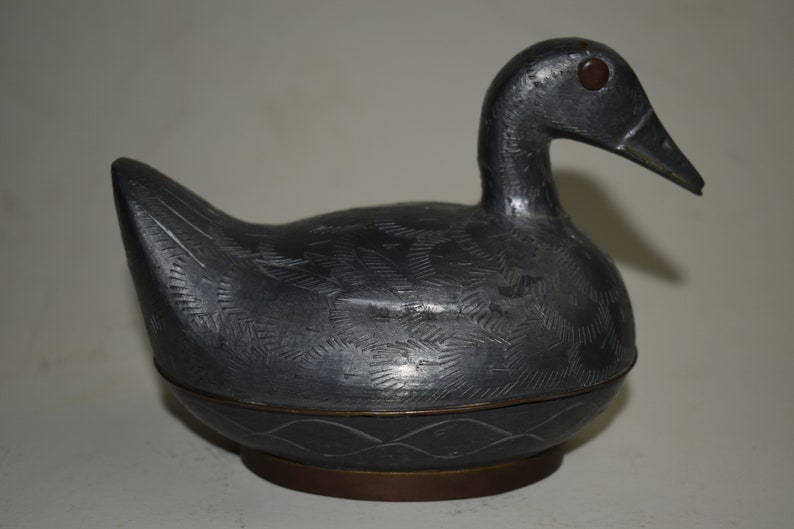
When I first saw this dresser box, I didn’t think it was in fact a dresser box. Being in the shape of a duck, I thought that it was just a sculpture for someone to put on a bookshelf or even their desk.
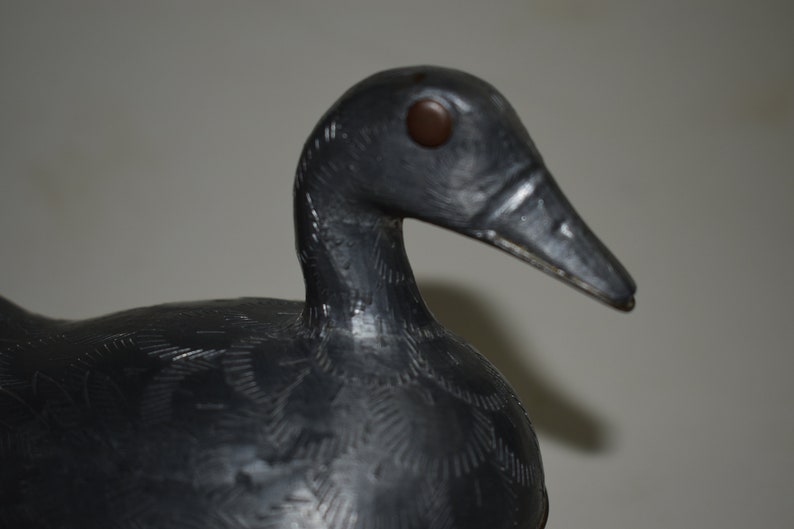
I quickly realized that it was a dresser box when I picked it up. When I did, the duck also surprised me that it was made of pewter—I thought that it was pottery with a silver glaze.
The duck was made in about the 1950’s in Hong Kong and has a really cool stamped motif on the body of it. Not only that, but the eyes of the duck are also made of brass.
You can see this cool duck in my shop on Etsy here. Head on over and check it out!
I have been attending auctions since I was 8, and I know that they have been around since the times of ancient Rome. What are some fun facts when it comes to auctions?
Some of the first auctions were held in ancient Rome. Like modern times, the people of ancient Rome would sell off household goods like furniture to pay off debts. These auctions could last for months.
When the items that were seized by the Army during the American Civil War, they would be sold by the Colonel of the Division. That’s why you see some auctioneers carry the title of “Colonel”.
With the invention of the internet, it is now very possible to find and attend any auction that you could ever want. This is a great way to help you find that piece that can help you complete your collection.
This is just a handful of fun facts about auctions. What fun facts have you heard?
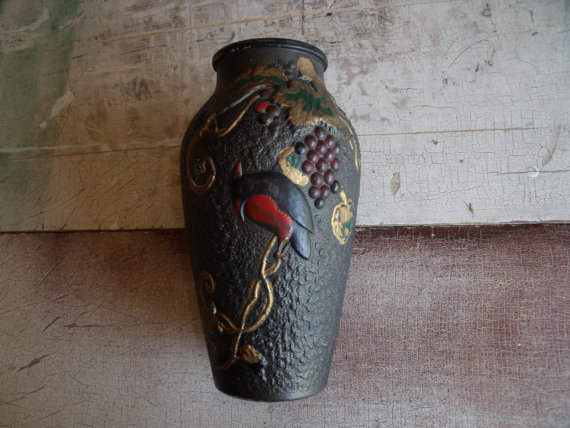
Goofus glass was made in the early 1900’s and was the first type of carnival glass giveaway because it was relatively cheap to make. Plates, bowls, vases (like the one above), and even oil lamps were made in mass quantities.
The glassware was also made with highly decorative patterns like the one on the vase above. The pattern on the vase featured here is called, “Odd Bird Sitting On A Grape Vine.” The bird on the vase looks like it could have come out of a comic book!
The great thing about goofus glass is that it comes in a wide variety of colors form what’s on the vase to red, gold and even green. With a wide variety of colors and shapes, you could find the perfect piece and color combination for any room.
One thing that you need to keep an eye on is the paint itself. Since the paint was not fired on, it tends to flake off. So if you are patient, you will find a piece of Goofus Glass with all of its original paint intact.
Another thing that’s great is that goofus glass can be seen from flea markets to swap meets to even antique stores and shows. You never know what you’ll find where!
What kinds of patterns and pieces of goofus glass have you found or run across?
Whenever you go out to an antique mall, flea market or even an auction, you will hear some terminology that describes areas of collecting.
Here are a few words that you will run across when you hear people talk about glass:
Frosting—this is a matte finish that is produced by exposing the glass item to fumes of hydrofluoric acid. This is also a small patch of surface cracks by weathering.
Ice glass—this is a decorative effect that causes the surface of the glass to resemble cracked ice. This is accomplished by plunging a piece of hot glass into cold water as quick as possible. This process creates a finish to the glass that resembles cracks.
Luster—this shiny metallic effect is made by painting the surface of the glass item with metallic oxides that is dissolved in acid and mixed with an oily medium. The item is fired in oxygen free conditions which cause the metal to deposit a distinctive shiny surface after it is cleaned.
Opal glass—this is a glass item that looks like an opal being translucent and white, and it has a grayish or bluish tinge to it.
This is a small look at some of the words that you will hear about glassware. What are some of the words you ran across?
Directions play a part in quite a few different ways in life, including when you collect paper money from the early 1800’s. During this time, it was up to the banks to produce paper money. The banks would file for a charter with the United States government—this would allow the bank to produce their own paper money.
Collectors often look for paper money in a couple of ways for their collections—and going a certain direction will often help them out. They will look for a certain bank, city or even the state the money was produced in. I have even heard of collectors looking for anything that is west of the Mississippi. You could even look for something in the southern states like Alabama or even Louisiana.
The east coast area has quite a few different banks that offered paper money. This was true up to the Mississippi (the father west you went there were fewer banks to run into). The gold rush in California that started in 1848 was what helped bring some banks (and eventually a United States Mint in San Francisco) that far west.
If there was a major metropolitan area, the more banks were likely to be there. One way to keep things interesting is to only look for banks that were on the east side of town.
Even up north in places like North Dakota, Washington state and even Alaska have very few banks at all. There have been a few bills (collectors also call them “notes”) to turn up for a few banks in these states. For obvious reasons, these are highly sought after.
What cities and states have you seen on this type of paper money?
When you dive into the world of antiques and collectibles—especially glassware—you will find many different types of finishes applied to the item. Frosted glass, satin glass and even pearlescent glass are a few of the finishes that you will run across. Here are a few more that you will see:
Matte finish—this type of glassware has a non-shiny finish that was made by sandblasting or even applying an acid to dull the finish of the glass.
Luster—this has a shiny (almost a metallic effect) that was made by applying the glass with metallic oxides that were dissolved in acid and fired in a kiln. After cleaning, the glass has a distinctive shiny surface.
Acid etched—this is glassware that has been treated with an acid to produce a finish that has a frosted appearance.
This is a few of the different types of finished that you will run across. What types of finishes have you seen?
Did you know that there was actually a 2-cent coin that was produced by the United States mint?
The Two Cent piece officially ran from 1864 to 1872, but there was a copy made for collectors in 1873.
photo courtesy of Wikipedia.com
The economic turmoil of the American Civil War caused any and all government-issued coins to vanish from circulation (they were hoarded by the public) Even the Indian Head cent—which was made of bronze—was pretty much gone from circulation (The Coinage Act Of 1864 authorized the cent to switch to a bronze composition and the production of the Two Cent coin).
Even though there were other mints actively producing coins at the time, this coin was only produced at the mint based in Philadelphia. What this means is that there will not be a mint mark anywhere (which is the way this mint was marking the coins until 1980).
Two of the more famous die varieties happened in 1864. One is called the “large motto,” and the other is called the “small motto.” These two varieties deal with the motto, “In God We Trust.” The words IN, GOD, and TRUST has some small differences, while the word WE has the most differences. It all hinges on the size of it, and it is very noticeable. The WE on “large motto” is larger than the WE on the “small motto.”
Large motto photo courtesy of Wikipedia.comsmall motto photo courtesy of Wikipedia.com
The “small motto” is much scarcer than the “large motto.” The best idea is to keep an eye out for it in case you might walk across a case full of coins at a mall, or happen to be at a coin shop or show.
Pink, green, black and even red are only a few colors that you will see on glassware. There are so many that it will make your head spin! Here are some of the colors that you may have not heard of:
Jadeite—this is a type of glass for the table made of Jade-green opaque milk glass. Jadeite was popular in the United States in the mid-20th century and has a blue variety that’s called “Azur-ite”.
MONAX—this is a translucent white glass that has a faint blue hue when held up to the light. This unique colored glass is sometimes mistaken as milk glass (which is whiter in color).
Ruby Flashed glass—this is created by coating a clear glass with one or more thin layers of colored glass (this is also known as flashed glass). The colored glass can be either partly or completely etched away by using items like acid or sandblasting. This results in spots where the colored glass has been removed.
This is a ridiculously small portion of all the colors that you will run across. What have you seen?
There are the ultra-famous styles of furniture that everyone knows about (like Chippendale, Hepplewhite, or even Victorian) but did you know that there were quite a few styles that often were around with the more famous counterparts that are just not that well known?
The first one that I heard about that is like this is called DIRECTORIE. It ran from 1795 to about 1804 and ran the same time as the Sheraton and Duncan Phyfe styles (the Duncan Phyfe style is also called the Federal Style). Following the French Revolution, France was ruled by five directors. Any and all signs of royalty were thrown out the window, and furniture design was controlled by a Jury Of Arts and Manufactures. Greek, Roman, and even Egyptian influences are strong with the DIRECTORIE style.
The next style is called EASTLAKE and it ran from about 1879 to 1895. It ran the same time that Late French Provincial and the Victorian Styles were going on. This style was created by Charles Eastlake and achieved some popularity here in America and in England as well. The style had some Gothic flair going on and had some Japanese ornamentation as well. Cherry and Fruit were extensively used in the furniture of this style and had tile panels and conspicuous hardware that were used for decoration.
This is only a small portion of all the fantastic styles that I’ve heard of that really aren’t that well-known. What kinds of styles have you heard of?
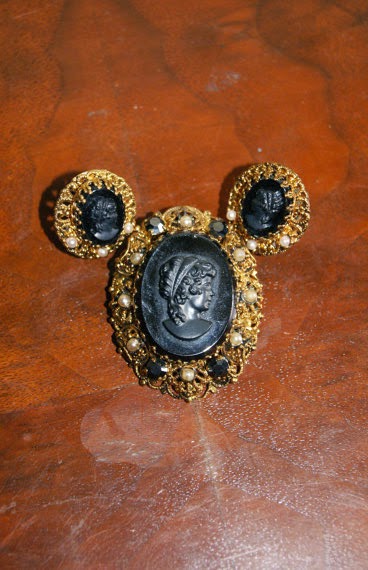
Cameo jewelry has been a popular item for many years now, and it comes in many scenes and sizes. Just what in the world is cameo jewelry?
Cameo is a method of carving an image into stone or shell that has a flat edge to it. More often than not, you will see a product that has multiple colors in it to give an extra pop to the carving. The cameos that are made of semi-precious stone like onyx and agate have examples that date all the way back to ancient Greece and Rome. The ones that are made of shell are more modern.
The cameo that is pictured above is the type that you would find that’s made in the late 1800’s into the 1900’s. As you can see, the piece features a picture of a person. I’ve seen several different motifs including more than one person, an animal, and the occasional flower.
The price of all cameos depends on what it’s made of and the quality of the carving on it. Some of the places to check are the hair, nose and facial features. The more features that are present and are vivid, it makes the cameo just that much better.
The great thing about this type of jewelry is that it can fit any budget and liven up any outfit at the same time.