HELP! What was this plaque used for?

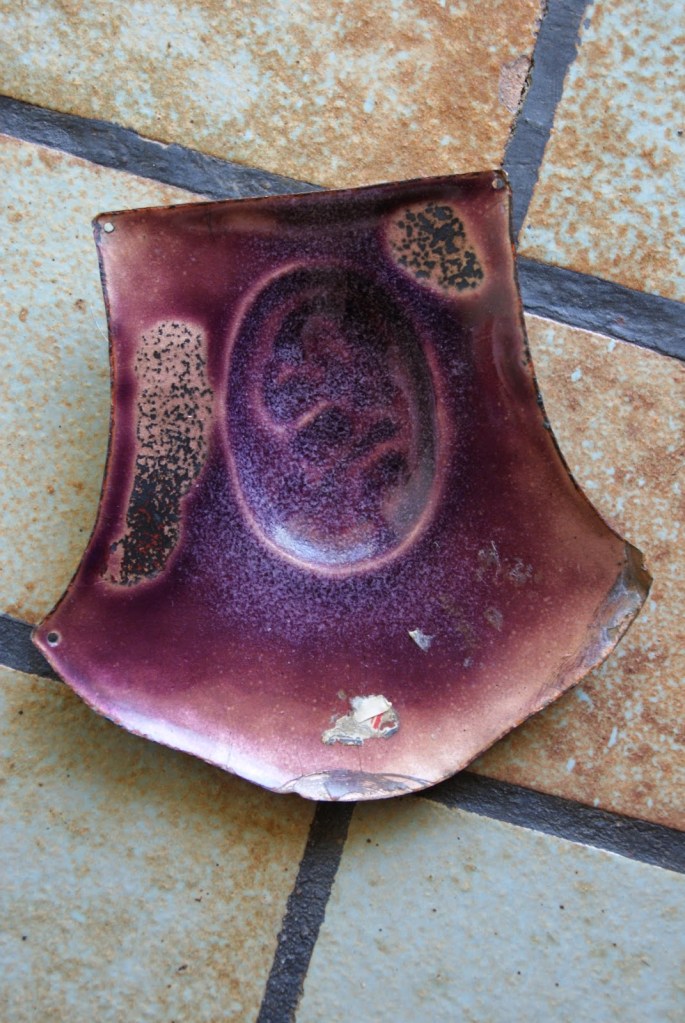
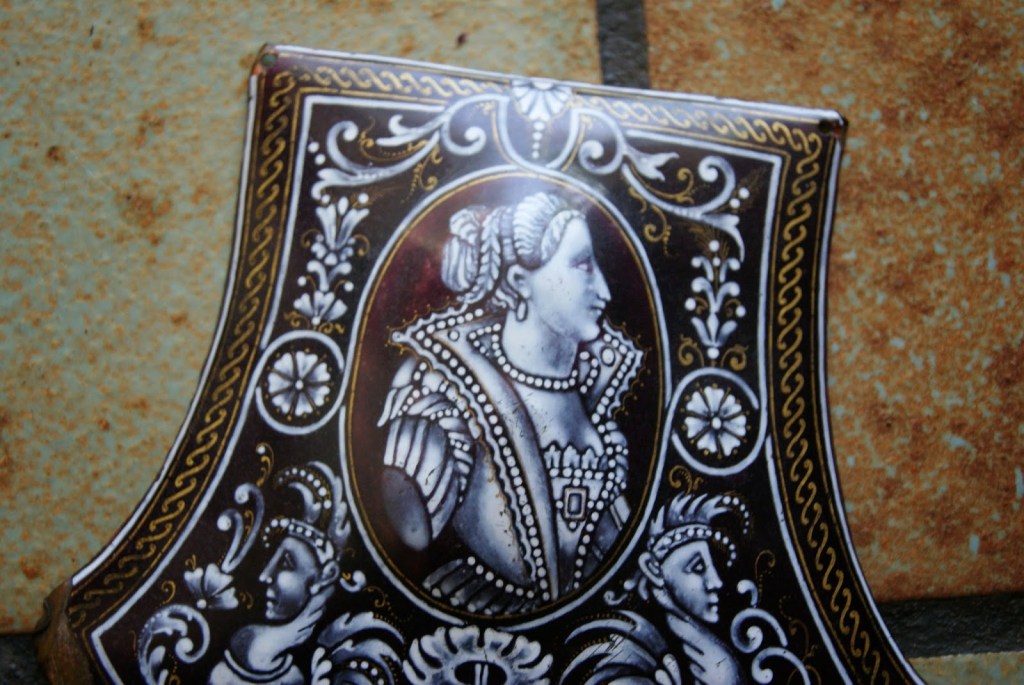
Several years ago, I picked up this brown and white enamel plaque that has a portrait of a woman on it.  When I purchased it, I was told by the dealer that it was a decoration off of the front of a stove that was made around the late 1800’s to the early 1900’s.

The dealer also said that they thought it was enameled copper.

Ever since the day I got it, I have been poking around to see what exactly it is.  The first thing that I ran across was a picture of Queen Elizabeth during her Diamond Jubilee of 1897.  The picture was pretty close to the image on the front of the plaque.

Another thing that really threw me for a loop was that I saw another listing on the internet that said these plaques were used on a front door of a house.

Bottom of front Is it really a decoration for a stove or a door?  Was it really made of copper?  If it was off of a stove, what brand was it on?  If you know what this is, feel free to drop me a line.  I would love to know is what this was used for.

What are some nicknames for paper money that is printed in the United States?

Greenbacks, moola, clams and even loot—we have all heard some of the nicknames for paper money.  What are some that may not be as well known?

We all know that the $1 bill is sometimes called a “single,” a “buck,” a “greenback” but did you know that it’s even called an “ace”?

The $2 bill is sometimes referred to as a “deuce” and it is even called a “Tom”.

The $5 bill has been referred to as a “fin”, “fiver” or even a “five-spot”, but did you know that the $10 bill is called a “sawbuck“?  And since we are talking about sawbucks, the $20 bill is also called a “double sawbuck”.

Horse racing gamblers are known to call the $50 bill a “frog” and it is considered unlucky.

The $50 bill is a “half a yard” while the $100 bill is called a “yard”, so $300 is “3 yards”.

“A rack” is $10,000 in the form of one hundred $100 bills that was banded by a bank.  The nickname “Blue cheese” is the new U.S. 100-dollar bill that was introduced in 2009 (this deals with the color of the bill).

The United States Mint has also printed $1000 notes occasionally, and they are referred to as “large” (“twenty large” being $20,000, etc.).

 In slang, a thousand dollars may also be referred to as a “stack” and is also known as a “band”.

$100,000 US dollars is called a “brick”. This is only a small portion of the nicknames for the United States money that you will run across.  What have you heard?

A Century Of Progress!

When the World’s Fair came to Chicago, it was called “A Century Of Progress International Exposition”.  It was originally to run from May 27th 1933 until November 12th 1933, but it was such a success that the Fair was opened again on May 26th the following year and ran until October 31st, 1934.

There were many exhibitors at the Chicago World’s Fair—some of the exhibitors were automobile manufactures (some of which are Cadillac, Nash, Pierce Arrow, Packard, and even Lincoln).  Another exhibitor was the Union Pacific Railroad, and they introduced their first streamlined train called the M-10000.

The Chicago World’s Fair of 1933-1934 has a vast area of souvenirs that you could collect.  There are programs, buttons, flyers, coins, badges, ash trays, photographs, tape measures (I’m not joking on the last one), banks, and the list just goes on and on.

I can find plenty of different items here in the Ozarks when it comes to collecting the Chicago World’s Fair.  The prices are all over the place, it really depends on how rare and well preserved the piece is.

The great thing about any World’s Fair is that every piece that came from it is marked with the year and the name of the Fair that it came from.

What kinds of collectibles have you run across from this World’s Fair?

MERRY CHRISTMAS!

Wow it’s Christmas Day!

When I was a kid, there were three days that I looked forward to.  They were Christmas Day, my birthday, and the last day of school.

Now that I’ve grown up, I look forward to Christmas to see what kinds of gifts that I can find my friends and family.

I hope that you get all of the gifts that you were wanting this year and have a great new year!

How do you bid at an auction?

You have your bidder’s number, and you have looked at all of the items at the auction.  What’s next?

At the beginning of every auction, the auctioneer will tell you what is going to go on throughout the auction.  They’ll tell you which items will sell first, and if they will auction the house off.  They’ll also say some other general announcements pertaining to the sale (like if they are selling off the furniture at a certain time).

The next thing to do is to wait for the items you want to bid on.  While you are listening to what’s going on at the auction, this is a great time to figure out what you would like to spend on what you saw before the start of the sale.  You also need to keep an eye on what they are selling as well.  I don’t know how many times I have bid on an item that is selling way too cheap.

This is also a great time to size up the competition.  What I do is to listen for a buyer’s number that is being repeated over and over again.  I will try to grab a peek at the person who is attached to the bidder’s number to see who it is.  After you attend a few auctions, you also notice the same faces showing up as well.

Be courteous and friendly to other bidders, especially your main competitors.  If they are behind you, or a little farther away from the auction than you, hand them the item that they just bought.  I also give people room for the items that they buy as well.  If you are a courteous bidder, most of the time the other auction-goers will be this way with you.

If a cheap item happens to come up for sale while I am waiting for the items that I really want to bid on, I will place a bid on it to let the auctioneer know that I am here to buy, not just to watch.  When you bid, you are introducing yourself to the auctioneer and the other bidders.  Don’t drive up bids to back out consistently.  Again, be courteous; others will extend the favor to you as well.

When you think about it, bidding for the first time buyer can be one of the scariest things to do.  It doesn’t matter if it’s a $200 Fenton Gone with the Wind Lamp, or a $2 toy.  I was nine years old when I bid for the first time.  Bidding for my mother, I learned a few things that I need to do so that I can be a successful bidder.

First, I learned not to jump in right away.  Auctioneers always try to set the price of the item high.  When they don’t get a bid, they will keep lowering the price until someone jumps all over it. 

I also learned that when bidding for the first time, you sometimes have to work to get the auctioneer’s attention.  Waive your arm, your bidder’s number, or shout “Yeah,” “Yes,” or even “Over here.”

There are quite a few ways to bid.  It ultimately comes down to what your personal preference is.  Mine is to stick my arm up in the air so that the auctioneer can see me.

Once you are noticed, you can even nod your head.  If you are standing behind the auctioneer or one of their employees that hold up item for sale, you could poke them in the back.

Raising an eyebrow, wagging a finger, or even raising your pen in the air are also great ways to bid once you are on the auctioneer’s radar.

If you are new to the world of bidding, experiment with what works for you.  You will come up with a great way that is perfect for you.

Happy bidding!

What a great way to repurpose a reproduction!

I’ve been attending auctions since my 8th birthday, and I had my first tiny space in an antique store at the age of 13.

There are times that I have to stop and think from time to time (and possibly even do some research) on an item that I am looking at.  There have been times that I chose to take a chance on an item that I’m unfamiliar with.

My taking a chance occurs when the item in question is very inexpensive.  Learning is a huge part of what I do every day.  My latest acquisition is the head vase that’s pictured below, which is marked NIPPON.

NIPPON never made any head vases.  I knew that—it registered wrong in my mind.  But I went ahead and carried it out to my car anyway.

It is well worth the price for the piece to become my display piece to showcase designer scarves, jewelry, and even hold vintage hats.

So, in the long run, it was worth the small amount I shelled out for it.  What kinds of finds have you re-purposed like this?

Fun facts of United States history from 1866

When I am trying to find some information on an item that I recently purchased, I run across some fun facts about the United States history.  Here’s some from the year 1866:

February 13 – The first daylight bank robbery happened on this date.  It was the first one during peacetime, and it happened in Liberty, Missouri.  People consider it to be the first robbery by Jesse James and his gang (although James’s role is disputed on this one).

May 16 – The U.S. Congress approved the production of a 5-cent coin (which is made from nickel). The minting of this coin eliminated its predecessor, the half dime.

July 24 – During the American Reconstruction, the state of Tennessee becomes the first state to be readmitted to the Union following the American Civil War.

It’s always fun for me to see these fun facts, I never know what I will run across. What fun facts have you run across?

What are some different types of joints that you will find in furniture?

When it comes to the construction of furniture, there are many different types of joints that you could use.  Butt joints, pocket-hole joints, lap joints and even mitre joints are commonly used, and here are some more that you will run across:

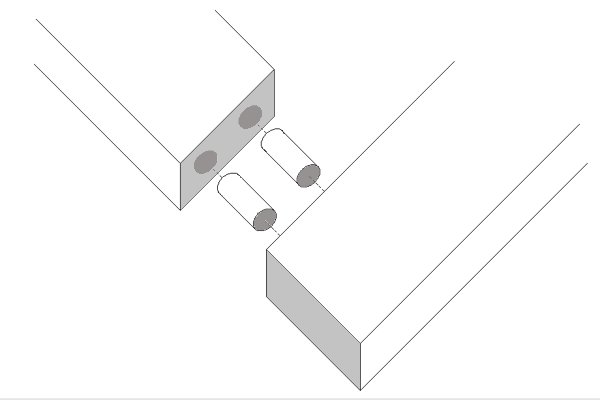
Dowel joint—this joint is at the end of a piece of wood that is butted up against another piece, and it is reinforced with dowel pins (there are holes drilled on each side of the joint for the dowel pins to be slid into).  This joint is a very common joint when it comes to furniture that is made in a factory.

picture courtesy of Wikipedia.com

Mortise and tenon—this features a small piece of wood (called the tenon) that fits tightly into a hole that is specifically cut for it (this is called the mortise).  Not only will you find this in furniture, you will also find it in in doors, windows, and even cabinets.

photo courtesy of Wikipedia.com

Dovetail—this is a set of right-angle joints that held together by interlocking fan-shaped tenons.

photo courtesy of Wikipedia.com

This is just some of the types of joints that you will find in furniture.  What kinds of joints have you run across?

More Fenton colors that you will run across

When Fenton was in business, they made many colors of glassware.  Milk glass, amethyst and even marigold carnival glass are only a few colors that Fenton has made—and there are many, many more out there.

Here are a few more colors that you will run across while shopping at your favorite places:

Chocolate Glass—this glass was originally made from 1907 to 1910 and then again in 1976.  This is made in a lighter latte color to a darker brown.  You will also hear it called Carmel slag glass and it was created by glass maker Jacob Rosenthal.

Photo courtesy of Worthpoint.com

Blue Marble—this was made from 1970 to 1973, and it is blue with swirls of white.

Independence Blue—this was made from 1975 1976, and it is a cobalt blue carnival glass  made during the Bicentennial.

Photo courtesy of Worthpoint.com

This is a small portion of colors that you will be able to find while shopping.  Which colors have you run across?

Silent And Early Talkie Film Star MAE W MARSH

Mae W Marsh Was an American actress whose career spanned over 50 years.  Her career started out in silent movies, and then went over into “talkies.”  Her big break came when Mary Pickford refused to play the role of Lily-White in the movie “Man’s Genesis” (Mary Pickford was known for “Rebecca of Sunnybrook Farm” and “Cinderella”).

Picture courtesy of Wikipedia.com

Some of the movies that she stared in were “The Dear One,” “The Birth of a Nation,” “The Grapes of Wrath,” “How Green Was My Valley,” and even “When Kings Were the Law.”

She became such a famous actress that her image was featured on several items, including this plate:


The plate was produced in the 1920’s by the STAR PLAYERS PHOTO COMPANY.  This is a part of a series of plates that features other famous actors, like Charlie Chaplin.

The plates that I have seen have considerable wear to them, like they were actually used instead of just being admired.  I also have yet to see one without any chips on them as well (the one in my Etsy shop has a very small chip on the back).

The great thing about it is that it is a cross-collectible.  Pottery, collector plate, movie buffs, and even people who love Mae Marsh would love to have this plate in their collection.  Not only that, you could also display this in a retro kitchen in something like an old Hoosier cabinet.

What was your favorite movie that Mae Marsh was in?