MERRY CHRISTMAS!

Wow it’s Christmas Day!

When I was a kid, there were three days that I looked forward to.  They were Christmas Day, my birthday, and the last day of school.

Now that I’ve grown up, I look forward to Christmas to see what kinds of gifts that I can find my friends and family.

I hope that you get all of the gifts that you were wanting this year and have a great new year!

How do you bid at an auction?

You have your bidder’s number, and you have looked at all of the items at the auction.  What’s next?

At the beginning of every auction, the auctioneer will tell you what is going to go on throughout the auction.  They’ll tell you which items will sell first, and if they will auction the house off.  They’ll also say some other general announcements pertaining to the sale (like if they are selling off the furniture at a certain time).

The next thing to do is to wait for the items you want to bid on.  While you are listening to what’s going on at the auction, this is a great time to figure out what you would like to spend on what you saw before the start of the sale.  You also need to keep an eye on what they are selling as well.  I don’t know how many times I have bid on an item that is selling way too cheap.

This is also a great time to size up the competition.  What I do is to listen for a buyer’s number that is being repeated over and over again.  I will try to grab a peek at the person who is attached to the bidder’s number to see who it is.  After you attend a few auctions, you also notice the same faces showing up as well.

Be courteous and friendly to other bidders, especially your main competitors.  If they are behind you, or a little farther away from the auction than you, hand them the item that they just bought.  I also give people room for the items that they buy as well.  If you are a courteous bidder, most of the time the other auction-goers will be this way with you.

If a cheap item happens to come up for sale while I am waiting for the items that I really want to bid on, I will place a bid on it to let the auctioneer know that I am here to buy, not just to watch.  When you bid, you are introducing yourself to the auctioneer and the other bidders.  Don’t drive up bids to back out consistently.  Again, be courteous; others will extend the favor to you as well.

When you think about it, bidding for the first time buyer can be one of the scariest things to do.  It doesn’t matter if it’s a $200 Fenton Gone with the Wind Lamp, or a $2 toy.  I was nine years old when I bid for the first time.  Bidding for my mother, I learned a few things that I need to do so that I can be a successful bidder.

First, I learned not to jump in right away.  Auctioneers always try to set the price of the item high.  When they don’t get a bid, they will keep lowering the price until someone jumps all over it. 

I also learned that when bidding for the first time, you sometimes have to work to get the auctioneer’s attention.  Waive your arm, your bidder’s number, or shout “Yeah,” “Yes,” or even “Over here.”

There are quite a few ways to bid.  It ultimately comes down to what your personal preference is.  Mine is to stick my arm up in the air so that the auctioneer can see me.

Once you are noticed, you can even nod your head.  If you are standing behind the auctioneer or one of their employees that hold up item for sale, you could poke them in the back.

Raising an eyebrow, wagging a finger, or even raising your pen in the air are also great ways to bid once you are on the auctioneer’s radar.

If you are new to the world of bidding, experiment with what works for you.  You will come up with a great way that is perfect for you.

Happy bidding!

What a great way to repurpose a reproduction!

I’ve been attending auctions since my 8th birthday, and I had my first tiny space in an antique store at the age of 13.

There are times that I have to stop and think from time to time (and possibly even do some research) on an item that I am looking at.  There have been times that I chose to take a chance on an item that I’m unfamiliar with.

My taking a chance occurs when the item in question is very inexpensive.  Learning is a huge part of what I do every day.  My latest acquisition is the head vase that’s pictured below, which is marked NIPPON.

NIPPON never made any head vases.  I knew that—it registered wrong in my mind.  But I went ahead and carried it out to my car anyway.

It is well worth the price for the piece to become my display piece to showcase designer scarves, jewelry, and even hold vintage hats.

So, in the long run, it was worth the small amount I shelled out for it.  What kinds of finds have you re-purposed like this?

Fun facts of United States history from 1866

When I am trying to find some information on an item that I recently purchased, I run across some fun facts about the United States history.  Here’s some from the year 1866:

February 13 – The first daylight bank robbery happened on this date.  It was the first one during peacetime, and it happened in Liberty, Missouri.  People consider it to be the first robbery by Jesse James and his gang (although James’s role is disputed on this one).

May 16 – The U.S. Congress approved the production of a 5-cent coin (which is made from nickel). The minting of this coin eliminated its predecessor, the half dime.

July 24 – During the American Reconstruction, the state of Tennessee becomes the first state to be readmitted to the Union following the American Civil War.

It’s always fun for me to see these fun facts, I never know what I will run across. What fun facts have you run across?

What are some different types of joints that you will find in furniture?

When it comes to the construction of furniture, there are many different types of joints that you could use.  Butt joints, pocket-hole joints, lap joints and even mitre joints are commonly used, and here are some more that you will run across:

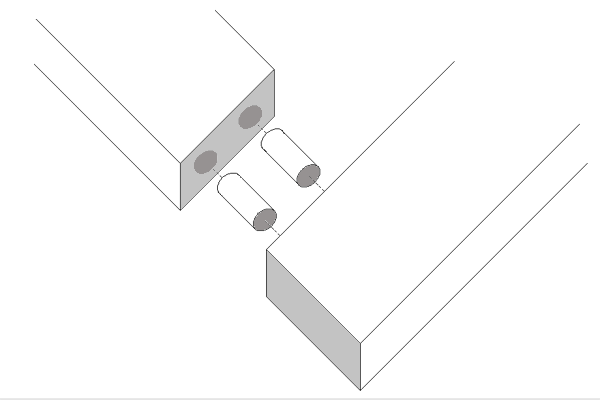
Dowel joint—this joint is at the end of a piece of wood that is butted up against another piece, and it is reinforced with dowel pins (there are holes drilled on each side of the joint for the dowel pins to be slid into).  This joint is a very common joint when it comes to furniture that is made in a factory.

picture courtesy of Wikipedia.com

Mortise and tenon—this features a small piece of wood (called the tenon) that fits tightly into a hole that is specifically cut for it (this is called the mortise).  Not only will you find this in furniture, you will also find it in in doors, windows, and even cabinets.

photo courtesy of Wikipedia.com

Dovetail—this is a set of right-angle joints that held together by interlocking fan-shaped tenons.

photo courtesy of Wikipedia.com

This is just some of the types of joints that you will find in furniture.  What kinds of joints have you run across?

More Fenton colors that you will run across

When Fenton was in business, they made many colors of glassware.  Milk glass, amethyst and even marigold carnival glass are only a few colors that Fenton has made—and there are many, many more out there.

Here are a few more colors that you will run across while shopping at your favorite places:

Chocolate Glass—this glass was originally made from 1907 to 1910 and then again in 1976.  This is made in a lighter latte color to a darker brown.  You will also hear it called Carmel slag glass and it was created by glass maker Jacob Rosenthal.

Photo courtesy of Worthpoint.com

Blue Marble—this was made from 1970 to 1973, and it is blue with swirls of white.

Independence Blue—this was made from 1975 1976, and it is a cobalt blue carnival glass  made during the Bicentennial.

Photo courtesy of Worthpoint.com

This is a small portion of colors that you will be able to find while shopping.  Which colors have you run across?

Silent And Early Talkie Film Star MAE W MARSH

Mae W Marsh Was an American actress whose career spanned over 50 years.  Her career started out in silent movies, and then went over into “talkies.”  Her big break came when Mary Pickford refused to play the role of Lily-White in the movie “Man’s Genesis” (Mary Pickford was known for “Rebecca of Sunnybrook Farm” and “Cinderella”).

Picture courtesy of Wikipedia.com

Some of the movies that she stared in were “The Dear One,” “The Birth of a Nation,” “The Grapes of Wrath,” “How Green Was My Valley,” and even “When Kings Were the Law.”

She became such a famous actress that her image was featured on several items, including this plate:


The plate was produced in the 1920’s by the STAR PLAYERS PHOTO COMPANY.  This is a part of a series of plates that features other famous actors, like Charlie Chaplin.

The plates that I have seen have considerable wear to them, like they were actually used instead of just being admired.  I also have yet to see one without any chips on them as well (the one in my Etsy shop has a very small chip on the back).

The great thing about it is that it is a cross-collectible.  Pottery, collector plate, movie buffs, and even people who love Mae Marsh would love to have this plate in their collection.  Not only that, you could also display this in a retro kitchen in something like an old Hoosier cabinet.

What was your favorite movie that Mae Marsh was in?

The ever-changing marketplace

Today’s hot buys in the secondhand marketplace might be stone cold by the time you decide to begin unleashing them on the public.  Buyers are very fickle when it comes to what they buy.


Shabby chic could be in one year, then fifties modern the next.  It could be Depression glass even.  Several years ago here in my area, Jadeite was white-hot.  You could not keep it on the shelves, no matter what the piece (or the price) was.  You know what?  Now you can’t give it away, even if you mark it as “FREE.”

As a dealer, you must be willing to change with the times.  You might love kerosene lamps and high-priced graniteware, so you’ve filled your shelves with them.  The guy next to you is unloading advertising signs and designer marked jewelry.

You have to learn to watch.  Then you have to anticipate and move or the crowd in the isle will pass you by.

What kinds of items are selling in your area?

A few tips for a successful garage sale

I see them everywhere, especially during the spring and early summer months.  Garage sales are absolutely fun to go to, but how do you have a successful one of your own?

One thing that helps is to put out a lot of signs where you’re most likely to snag the most traffic.  The signs must be visible from the street, and even give the address of your sale.  It even helps to give the time and dates of your sale.

The next thing you need to do is to make your merchandise accessible.  The items that are not in the sale need to be either covered with a sheet or tucked away somewhere else if possible.  Dust or clean the things going into the sale.  A clean, well-organized sale does so much better.

Don’t overprice your items.  We’ve all gone to sales where the garage sale prices were higher than the original sticker price—and we have left shaking our heads in disbelief.

For your own safety, don’t allow strangers to enter your home to use the bathroom or the phone.  They just might be casing your house to see what you have for the possibility of a robbery.

Be willing to entertain a good offer (not 50 cents for a 50 dollar item).  If the offer is a little low, you can always give a counteroffer.

Be friendly with the people that come by—but don’t sit and stare at your customers.  In a way, they are your guests.  But at the same time, don’t allow bad manners (it’s your sale after all).

If you’re willing to do this, your garage sale will be a hit.  You might even just sell out of everything!

War Rationing affected even the fashion industry!

When World War II started, rationing started with petrol and it eventually covered items like sugar, meat, cooking oil, and even canned goods.  Every American was issued a series of ration books during this time, and the ration books contained removable stamps that you could use to get items that were being rationed.

If you didn’t have the necessary stamps, then you could not get what you need.

Rationing covered a lot of things, but did you know that it even covered items like leather?

That’s whats going on with this purse—instead of using leather, the manufacturer used vinyl instead of leather.  The interior of this remarkable find reads NON-LEATHER 1943 (the ration on leather ran from 1943 to 1945).

You can see this terrific find in my Etsy shop here.  Head on over and check it out.

What kinds of items like this have you run across?