What are some of the terms that you will run across when you start to collect stamps?

Not too long ago, I went to a local auction that had quite a few stamps for sale.  There were some stamp collectors and dealers there talking about “changelings” and even an “album weed”.  It made me think—what are some of the terms that you’ll run across when you collect stamps?

Album weed—this refers to a forged stamp, and it also refers to unusual items that resemble postage stamps but were not intended to pay postage.  This is something like publicity labels and bogus issues.

Album Weeds—this is the title of a reference book series that is on forged stamps.  It was written by R.B. Earee.

Changeling—this is a stamp whose color has been changed (either intentionally or unintentionally) by contact with a chemical.  This can also happen with the exposure to a light.

Encased postage stamp—this is a stamp that was inserted into a small coin-size case.  The case comes with a transparent front or back to see the stamp.  These were circulated as legal coins during periods when coins were scarce in the 1860’s.

Handstamp—this is a cancellation or overprint that was applied by hand to either a cover or to a stamp.

Obliteration—there are two main definitions for this term.  The first is a cancellation that was intended solely to deface a stamp (this is also called a killer).  The second is an overprint intended to deface a portion of the design of a stamp (such as the face of a deposed ruler).

This is just a few of what you’ll hear when talking about stamps.  What terms have you heard?

Reader’s Help: Who exactly made these framed vintage prints?

At a local estate sale, I recently came upon four framed vintage prints.  I looked at them and instantly fell in love with them.  The only problem was was that I have no idea who could have made them.

Picture help

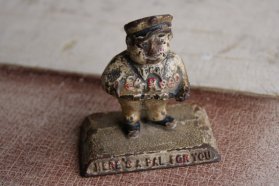
They look to be famous Scotsmen, and they are professionally framed and matted.  To me, the illustrations themselves look like they could have come from a book.

They also appear to have a CURRIER AND IVES look to them.

I have not been able to track down any information about the artist and who could have printed them.

Does anyone know who could have done these great prints?  Any information is greatly appreciated!

Look at all the different names that coins go by!

When I picked up my first copy of the Guide Book of United States Coins Book by Richard S. Yeoman (this is also called the “red book”), I noticed that there were tons of names and nicknames that coins go by.

It really made my head spin—I had to stop and figure out what was what.  I realized that coins often get nicknames that are more popular than their real name.  Here’s some of the nicknames that you will hear:

Half eagle—this is another name for a United States $5 gold coin.

Eagle—this is a nickname for gold $10 coins that were made up until 1932.  The reason for the nickname is that the coin featured an eagle design on the back.

Trime—this is a nickname for the US three cent coin.  The US mint made this coin in the 1800s.

Double dime—this is a nickname for the 20-cent coin made by the United States mint during the mid-late 1800’s.

Iron dollar—this is a nickname for the US silver dollar from the 1800’s.  The phrase was primarily used in the northeastern portion of the United States, and this phrase was used by people who disliked carrying silver dollars due to their heavy weight.

Mercury dime—this nickname was for the US 10 cent piece that was made between 1916 and 1945.  Even though it was called the Winged Liberty Head dime at the beginning, the name “mercury” dime quickly caught on with the public when it was compared to the Roman god Mercury.

This is just some of the nicknames that you will hear.  Which ones have you heard?

Reader’s help on this great pottery vase

Whenever you go out shopping, you will run across a wide variety of items.  It could be anything from furniture to enamel signs.  There will be times that you will run across something that is great—the only problem is is that you have no idea what the item is.

Not too long ago, this happened to me.  I picked this really cool vase up at a garage sale, and I instantly fell in love with it.

vase (1)

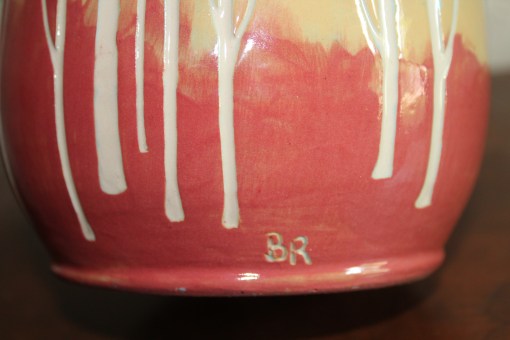
The problem that I have with it is that I have no idea who the artist is and what the pattern is called.  Is it a forest scene?  A forest scene at night time?  At the beach?  At a pond?  I really don’t know what this could be.

vase (2)

It’s also signed BR near the bottom of the vase.  The signature has really stumped me—could you possibly know who the artist is?

Do you know what this could be?  Any information on this beauty would be greatly appreciated!

What are some shopping tips for anyone who is new to the vintage scene?

When you first start to shop for vintage and collectible items, it can be intimidating.  What are some tips that can help you out?

One misconception is to get there early.  I know that you hear “get there early!” or “the early bird gets the worm”, but I can tell you that’s not always the case.  There have been plenty of times when I have found great items at 10am or even at 2 in the afternoon.

Look in the weird spots—you never know what you will find hiding in the bottom corner or the very top shelf of the booth.

Shop with someone.  It could be anyone—a friend, wife, husband or even a family member.  This will bring another set of eyes to the place that you are shopping.  I don’t know how many times I have walked by a booth and saw nothing and then a family member found something great where I was looking.  Not only that, they will also be on the look out for completely different items that you normally don’t go looking for.

Your shoe choice could come back and haunt you.  This might sound silly, but it really can.  I constantly see someone wearing a pair of stylish shoes that eventually start to hurt them.  At the very least, bring a pair of comfortable tennis shoes with you in case your feet start to hurt.

This is only a handful of the tips that will come in handy when you are shopping for vintage and collectible items.  What are some of the tips that you have run across?

What a great carnival glass plate from Fenton!

When the 1900’s rolled around, a new form of glassware was introduced.  Over the years, it has become to be known as Carnival Glass—and there is a wide variety of manufacturers, shapes and colors.

Carnival glass was at the height of its popularity in the 1920’s when Fenton produced this terrific 12-Sided Amethyst Footed Plate with the THREE FRUITS pattern.

3

This terrific item is called a 12-sided plate because of the edge that it has—not only does it have a scalloped edge, it has 12 noticeable segments to it.

The THREE FRUITS pattern that is featured on this plate are cherries, pears, and apples.  Not only is the amethyst color great for just about any room, the pattern will also look great as well.

This great plate can be seen in my Etsy shop here.  What other great carnival glass items have you run across?

Is that early movie star MAE W. MARSH?

Mae W. Marsh was a huge movie star in the 1920’s—going from silent films to talkies.  She made nearly 100 films in her lifetime, and her career spanned 50 years.  Some of these movies include THE LESSER EVIL (1912), THE ESCAPE (1914) and even TIDES OF PASSION (1925).

Mae was a prolific actress, sometimes appearing in as many eight movies a year.  She also became a very popular actress, and she was featured on this terrific plate by STAR PLAYERS PHOTO COMPANY.

Mae W Marsh plate

STAR PLAYERS PHOTO COMPANY produced this fantastic plate in the 1920’s.  This plate with Mae W. Marsh was part of a series by the company that featured other movie stars.  This series had Charlie Chaplin, Anita Stewart, Francis X. Bushman, Marguerite Snow, Alice Brady, Maurice Costello, Lottie Pickford, Lillian Walker and other actor and actresses.

All of the plates in this set features a floral border, and a picture of the star in the center of the plate.  They are also the same size—they are about the size of a dinner plate.

What a wonderful find for the film buff, and you can see this great plate in my Etsy shop here!

What are some of the different types of plates that you will run across?

One of the first auctions that I attended, I found out that there are different types of plates when it comes to a set of dishes.  Here are some of the more popular ones that you will run across:

Dinner Plates—they are flat and usually round (there are other shapes like square out there).  Dinner plates range in size from 9 ¾ inches to 11 inches in diameter.

Salad Plate—these are also known as a side plate.  They are flat and usually round and range in size from 7 ¾ inches to 8 ¾ inches in diameter.

Bread & Butter Plate—these are also known as a dessert plate or even a cake plate.  Like salad plate, this type of plate is flat and usually round.  They range in size from 6 inches to 7 ¾ inches in diameter.

Luncheon Plate—they are often confused with the dinner or salad plates.  Luncheon plates are flat and usually round, ranges from 9” to 9 3/4” in diameter.

This is only a sample of all the different types of plates that you will run across.  What other types of plates have you seen?

Great SALE items from Wisdom Lane Antiques!

Currently in the Wisdom Lane Antiques shop on Etsy, I have some great items on SALE with prices that have been reduced!

There is a wide variety of items in the SALE section in my shop from vintage dresses to a trolley sign.  One of the items in the section right now is this great vintage purse from the 1960’s.

1

This purse has a great silver tone pierced metal top with snap closure and aurora borealis stones on it.  It would look great in any formal event or even out on the town!  You can see it in my Etsy shop here.  Another great item that’s on sale is this trolley sign.

2

This great trolley sign is an advertisement for EDISON MAZDA LAMP, and it dates from the early 1900’s to the early 1920’s.  You can see it in my Etsy shop here.

This terrific Pretty In Pink lace prom dress by Dawn Joy Fashion is also currently on sale.

3

The dress dates to the 1980’s, and it also has the original tags on it.  Not only would this dress be great for the prom, it also would be great for a wedding or a formal dinner.

You can see this dress in my Etsy shop here.

As a matter of fact, you can see all of the great items on sale in my Etsy shop here!  Head on over and check them out!

Things to consider after you attended an auction

Now that you have attended an auction, paid for everything and took all your purchases home, what are some things to consider?

After you figure out what you want to keep for yourself and what you want to sell, the first thing to do is to figure out where you are going to sell the item.  It could be at a flea market, an antique booth or even online.

When you know you where you are going to sell the item, you need to get a little history about the item.  Where it was made, who made it and even a good time frame when it was made will help any customer when they are interested in it.

Repairs may be inevitable before you sell the item, and you will have to take this into consideration when you go to price the item.  The cost of any repairs that you may make will drive the price of the item up.

These are only a few of the things to consider after you attend an auction.  What kinds of things do you run across after you attend an auction?