READER’S HELP: that’s a friendly wall-crawling superhero…made from plaster?

When you start to dive into the world of antiques and collectibles, you quickly find out that you will find really cool things in unexpected places.

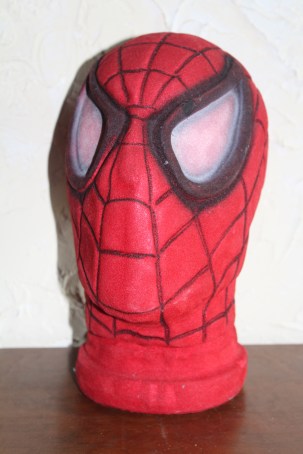
Not too long ago, this happened to me when I came upon a local garage sale.  And do you know what was there?  Just a bust of Spiderman himself!

Spiderman bank (1)

As you can see in the photo, the bust is made of plaster and it is also doubles as a bank (the coin slot is on the back of Spiderman’s head).  Not only that, it is extremely detailed—you can see and feel the ribbing in Spiderman’s mask, and it also feels like the head actually has cloth on it.

Spiderman bank (2)

Here’s the problem that I have with the bank—I know what it is, but I have no idea who made it.  I was told that it was made in Mexico, but there is no maker’s mark or even a country of origin mark on it.

Does anyone know who could have made this great bank?  Could it be a homemade piece that a fan of the character made?

Any information is greatly appreciated!

What a great gift idea for any stamp collector!

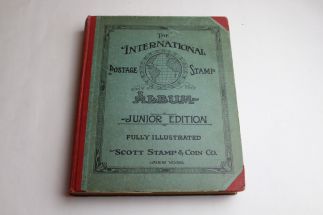
What a cool gift idea for a stamp collector—finding them a vintage stamp album to accompany their collection.  One album that you can find is titled “The International Postage Stamp Album Junior Edition.”

stamp book (0)

This album is great, it is by the Scott Stamp and Coin Company.  Not only does it have the look of a regular book, it has space dedicated to have stamps from many countries of the world.  Some of the countries that are included are the United States, Austria, Bavaria, Germany, Cuba and even Hungary (there are many other countries that are not listed here).

stamp book (1)

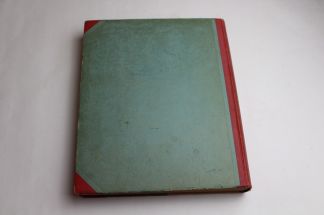
There is a copy of this book in my eBay shop—not only does it have all of its pages, it also has some stamps with it.  There are about 150 stamps in total that are included, and they range in date from 1876 to the 1920’s (two of the stamps from Hungary are OVERPRINTS from 1919).

You can see this book in my eBay shop here.  Head on over and check it out.

Wow, how great is this?  Remember when stamps were 1 cent?

Gas Station Collectibles from…ElReco?

As long as I can remember, people have been on the lookout for items that were once in use in gas stations.  Gas pumps, signs, vending machines and even advertising from a certain brand (like Marathon or even Phillips 66) have been sought after.

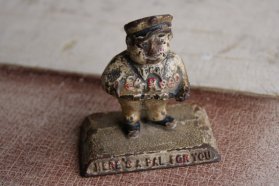
I have even heard of people collecting items from the lesser known gas station companies as well, like ElReco.  I am going to be honest with you—I never heard of ElReco until I found this paperweight.

EL RECO Gas Stations Figural Paperweight

It turns out that Elreco stands for the Eldorado Refining Company. They operated out of El Dorado, Kansas until the company was sold to the K-T Oil Company (they maintained operations there after the sale).

When 1958 rolled around, that company was sold American Petrofina, and the stations were then renamed to the FINA brand.

elreco back

This paperweight was made in the early 1900’s, and it still has a good amount of the original paint on it.  The great thing about this paperweight is that it’s a perfect size so that it can be used anywhere from your desk to holding down a recipe in the kitchen.

You can see this terrific paperweight in my Etsy shop here.  Head on over and check it out!

What in the world is an encased postage stamp?

In 1862, the United States was smack dab in the middle of a coin shortage.  It was bad, really bad.  Everything was being horded—even the cent was being stockpiled.

An American entrepreneur and inventor by the name of John Gault created something to help with this—the encased postage stamp.

The encased postage stamp is a stamp that was inserted into a small coin-size case.  This case has a transparent front or back. This type of “coin” was circulated as legal tender during periods when coins were scarce.

John Gault was pretty savvy—he saw two ways to make money off of his creation.   The first way was to sell them to businesses and stores that had a high demand for coins.  He sold his encased stamps at 20% of the face value of the stamp.

The second way that he made money was to sell the blank back of the case of the coin as advertising.  There is a minimum of thirty different companies that took up the advertising on the coins.  All of the different companies lend to find some great and different varieties on this type of coin.

Encased postage stamps circulated for about a year (until about the middle of 1863).  This is when the fractional currency released by United States Government became popular enough to help ease the coin shortage.

There were also some other factors that helped bring encased postage stamps to an end.  One reason was was that the postage stamps that were being used for this started to become unavailable.  Not only that, it cost more to buy the encased postage than what they were actually valued at in the market.

Encased postage stamps are rare today with a small fraction of the 750,000 that were originally sold surviving.

This is just one item people came up with over the years to help with coin shortages over the years.  Do you know of any other ways?

Is that early movie star MAE W. MARSH?

Mae W. Marsh was a huge movie star in the 1920’s—going from silent films to talkies.  She made nearly 100 films in her lifetime, and her career spanned 50 years.  Some of these movies include THE LESSER EVIL (1912), THE ESCAPE (1914) and even TIDES OF PASSION (1925).

Mae was a prolific actress, sometimes appearing in as many eight movies a year.  She also became a very popular actress, and she was featured on this terrific plate by STAR PLAYERS PHOTO COMPANY.

Mae W Marsh plate

STAR PLAYERS PHOTO COMPANY produced this fantastic plate in the 1920’s.  This plate with Mae W. Marsh was part of a series by the company that featured other movie stars.  This series had Charlie Chaplin, Anita Stewart, Francis X. Bushman, Marguerite Snow, Alice Brady, Maurice Costello, Lottie Pickford, Lillian Walker and other actor and actresses.

All of the plates in this set features a floral border, and a picture of the star in the center of the plate.  They are also the same size—they are about the size of a dinner plate.

What a wonderful find for the film buff, and you can see this great plate in my Etsy shop here!

What are some of the different types of plates that you will run across?

One of the first auctions that I attended, I found out that there are different types of plates when it comes to a set of dishes.  Here are some of the more popular ones that you will run across:

Dinner Plates—they are flat and usually round (there are other shapes like square out there).  Dinner plates range in size from 9 ¾ inches to 11 inches in diameter.

Salad Plate—these are also known as a side plate.  They are flat and usually round and range in size from 7 ¾ inches to 8 ¾ inches in diameter.

Bread & Butter Plate—these are also known as a dessert plate or even a cake plate.  Like salad plate, this type of plate is flat and usually round.  They range in size from 6 inches to 7 ¾ inches in diameter.

Luncheon Plate—they are often confused with the dinner or salad plates.  Luncheon plates are flat and usually round, ranges from 9” to 9 3/4” in diameter.

This is only a sample of all the different types of plates that you will run across.  What other types of plates have you seen?

Things to consider after you attended an auction

Now that you have attended an auction, paid for everything and took all your purchases home, what are some things to consider?

After you figure out what you want to keep for yourself and what you want to sell, the first thing to do is to figure out where you are going to sell the item.  It could be at a flea market, an antique booth or even online.

When you know you where you are going to sell the item, you need to get a little history about the item.  Where it was made, who made it and even a good time frame when it was made will help any customer when they are interested in it.

Repairs may be inevitable before you sell the item, and you will have to take this into consideration when you go to price the item.  The cost of any repairs that you may make will drive the price of the item up.

These are only a few of the things to consider after you attend an auction.  What kinds of things do you run across after you attend an auction?

Here’s some different type of dealers that you will find

There are several types of dealers that you will find, and some of the different types could be great for you to do if you are just getting started with antiques and collectibles.

Weekend dealers—these are dealers who shop at yard sales, garage sales, auctions and even estate sales on Fridays and Saturdays and then sell at flea markets on Sundays.  You can also find them in an antique mall occasionally, and this type of dealer is also called a “weekender”.

Vest pocket dealer—this is someone who buys and sells in coins but does not have a coin shop or store.  They also do not set up at coin shows, and they are often a part time coin dealer.  This type of dealer may not do a large volume of business, and they carry their coins that they are going to sell in their pockets.  Many coin dealers got their starts as vest pocket dealers.

Greeddobo—(greed-dough-bough) this is a term that is used by southern coin dealers for someone who is so caught up in making profits that they do stupid things or bad ideas to make money.  This term can be applied to just about any type of dealer who does this.

Wholesaler—this is a dealer who sells goods in large quantities at low prices to be sold off by others.

This is just a few of the different types out there.  What kinds of dealers have you run across?

A good example of Czechoslovakian pottery

Pottery from the Czechoslovakian area in Europe is a great area to dive into and collect.  You can find great examples starting in the $10 to $15 area, and you can also find examples that are priced much higher.

You can find a wide variety of pieces on the market—cups, saucers, figurines, pitchers, creamers, sugars and even plates are a very small slice of what you can find.

One type of Czechoslovakian pottery (also called Czech pottery, a shortened name of the region it’s from) is this terrific hat pin holder from a company called ROYAL DUX.

royal dux

It was made from 1918 to 1930’s, and it has a cream background and a red trim, and it also has an embossed flower motif with pastel colors.

Royal dux marks

The marks that are on it are the DPM mark with an acorn at the center (this stands for DUXER PORZELLAN-MANUFAKTUR), and it also has an embossed mark that reads 11259 II (these marks help date the hat pin holder from 1918 to the 1930’s).

The hatpin holder is also the perfect size to be used as a small vase (or even a bud vase).  It would also look terrific on any table or even a desk.  It would definitely be the center of attention in any room that it’s in!

The vase can be seen in my Etsy shop here.  Head on over and check it out!

What are some of the benefits of getting an item appraised?

You have a piece of jewelry from your grandmother, your dad’s vintage comic book collection from his youth, or even a piece of furniture that you picked up at an antique mall.  You know that the piece has value, and you are not sure if you want to get an appraisal on it.

What are some of the benefits of getting an item appraised?

There are several benefits when it comes to getting an appraisal.  The first reason (and probably best) is that it helps tell you the value of the item that you have.

The second reason is that it helps clear up any confusion on what the item is.  You could have heard several stories from the family, and each story identifies the item (or items) completely differently than what it actually is.

Another reason is that the appraisal helps you know if your item is real or not.  A good rule of thumb is to try to find someone who appraises items on a regular basis like what you have.  This will help with both the value and authenticity of the piece that you have.

When it comes to jewelry, the appraiser has equipment that helps determine what the types of stones that you could possibly have.

Another good benefit on appraisals is that you could also get everything written out telling what the item is.  This will also help with insurance (if it’s needed on the item).

What other types of benefits have you run across when you got an appraisal on an item you have?